
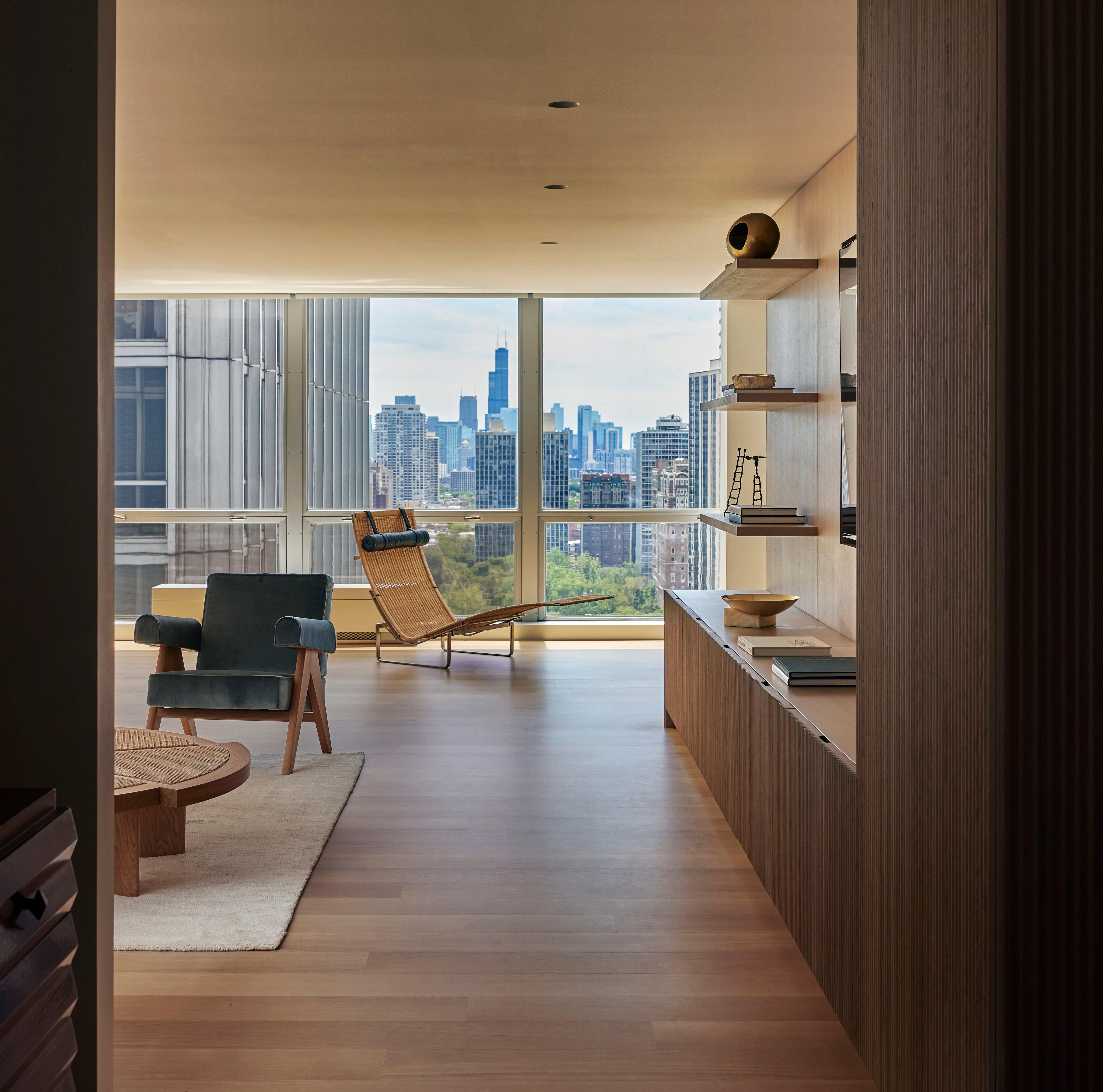
Architecture and design often meet with restraint, unfolding less as declarations and more as a conversation over time. At Chicago’s Commonwealth Promenade Apartments, that dialogue becomes both visible and deeply felt, a presence that settles into the rhythm of daily life.
Rising 27 stories along the city’s north side, the glass and steel towers designed by Ludwig Mies van der Rohe in 1956 stand as enduring expressions of the International Style. Their clarity of structure and discipline of form continue to resonate as living frameworks for contemporary life. Light moves across their surface with gentle precision, revealing a language that remains steady, measured, and deeply human.

Within this architectural landmark, Eric Rothfeder Architects was tasked with an ambitious transformation, uniting three separately acquired apartments into a single expansive residence. Their approach works in close conversation with Mies van der Rohe’s vision, allowing the original architecture to guide each intervention rather than recede into the background.
The resulting interior preserves the building’s inherent logic through its grid, its light, and its openness, while introducing subtle reinterpretations. Custom millwork echoes disciplined geometries and evolves them through finely crafted triangular profiles and chamfered edges, offering a quiet inflection that feels both intentional and precise.
Public spaces unfold along the southern exposure, where light and city views animate daily life and shift with the passing hours. Private rooms move to the north, where a more contemplative atmosphere allows for rest and stillness. The home breathes in two registers, one outward and luminous, the other inward and reflective.
This balance reflects a design process that extends beyond selection, one that considers how space is experienced, shaped, and ultimately lived in over time.

With this architectural foundation in place, Luminaire completes the conversation through furniture, selecting pieces that do not simply occupy space but actively participate in it.
Rather than assembling a collection, the furnishings form a continuum of ideas across time, a dynamic exchange between histories, materials, and intentions. Works by Pierre Jeanneret, including the Capitol Complex Armchair and Kangaroo Chair, echo the same structural clarity and material honesty found in the architecture.
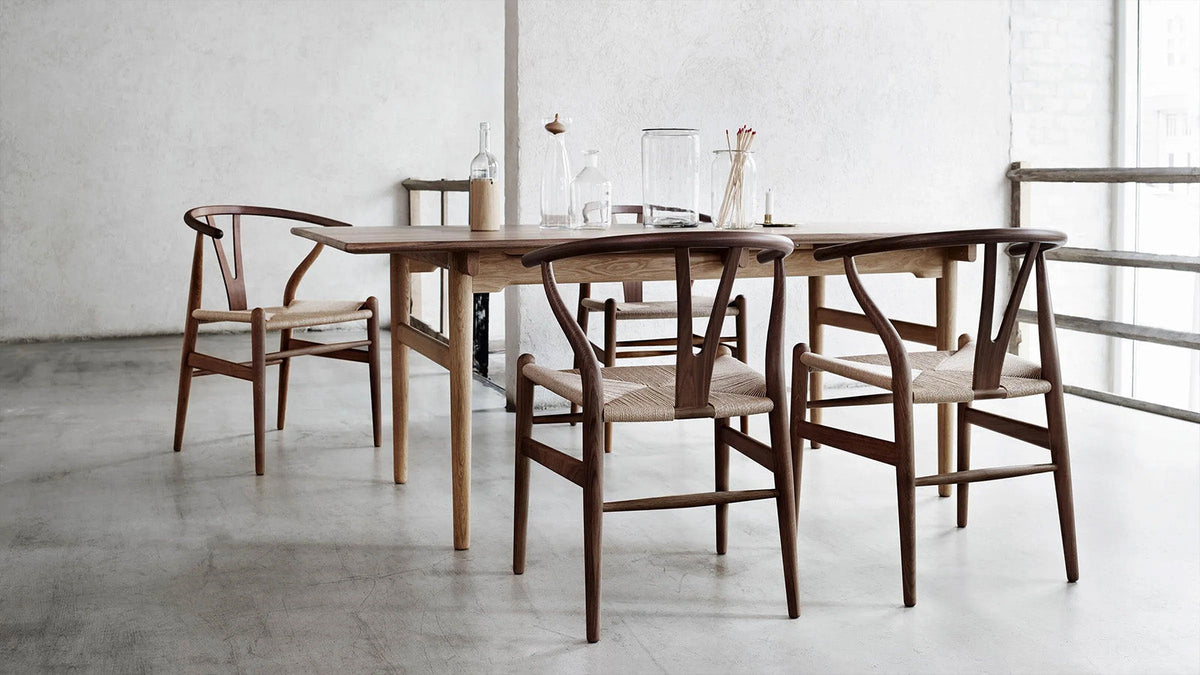
Alongside them, mid-century voices expand the dialogue. Charlotte Perriand’s Rio Low Table and Tabouret Stools introduce a grounded rhythm. Gerrit Rietveld’s Utrecht Chair introduces the language of De Stijl, while Hans J. Wegner’s Wishbone Chair bridges cultures through a gesture that feels both delicate and enduring.

These historical voices exist alongside contemporary works. The Mex Cube Sofa by Piero Lissoni brings a refined minimalism that aligns naturally with the surrounding architecture.
In the dining and kitchen spaces, a more tactile modernity emerges. Pieces such as Patricia Urquiola’s Dudet Chair and Jasper Morrison’s Hi Pad Stool bring an understated sense of luxury.

In the bedroom, the dialogue becomes more intimate. Marc Newson’s Wooden Chair reflects both the millwork and ethos of the space. Its alpha-curve silhouette carries a quiet sense of movement, balancing discipline with expressive potential.
What emerges is a layered conversation between past and present, between industry and craft, between precision and warmth. Nothing feels fixed, and nothing feels excessive. Instead, there is a steady rhythm that allows the space to feel composed yet alive.
Recently featured in AN Interior, this project demonstrates how collaboration between architecture and design extends beyond aesthetics. It reveals how spaces can hold memory while remaining open to reinvention.
Projects like this reflect Luminaire’s approach to the Total Design Experience, where concept development, product curation, and spatial understanding come together to create environments that feel cohesive and deeply considered.

There is a particular satisfaction in spaces where everything feels considered, where form, function, and atmosphere align with ease, and where the experience of being within them feels both natural and intentional.
We invite you to explore these ideas further by visiting a Luminaire showroom, or to connect with our design team to begin shaping your own space.
Whether beginning a new project or refining an existing one, the conversation continues, shaped by your perspective and brought to life through design.
Inside Luminaire Chicago: Italian Design in River North Since 1989
Read moreabout Inside Luminaire Chicago: Italian Design in River North Since 1989
Eileen Gray's E 1027 Table: A Design Conceived for Living
Read moreabout Eileen Gray's E 1027 Table: A Design Conceived for Living
LC14 Tabouret Cabanon: Le Corbusier's Smallest Architecture
Read moreabout LC14 Tabouret Cabanon: Le Corbusier's Smallest Architecture
Sacco Chair by Zanotta: The 1968 Object That Refused to Be Furniture
Read moreabout Sacco Chair by Zanotta: The 1968 Object That Refused to Be Furniture
Inside Luminaire Coral Gables: The Showroom and Its Design Services
Read moreabout Inside Luminaire Coral Gables: The Showroom and Its Design Services
The Wishbone Chair: Hans Wegner's CH24 and the Art of Making
Read moreabout The Wishbone Chair: Hans Wegner's CH24 and the Art of Making
Cassina Chairs - The Collectors' Guide
Few furniture makers have shaped the chair as a cultural object the way Cassina has. From their earliest collaborations with the European avant-garde to their ongoing stewardship of the twentieth century's most consequential seating designs, the Meda-based manufacturer remains the standard against which Italian furniture brands are measured. This guide surveys the Cassina chairs we carry and the ideas embedded in each one.
On the Rocks by Edra: Francesco Binfaré's Geology of Rest
Read moreabout On the Rocks by Edra: Francesco Binfaré's Geology of Rest
The 14p Portable Lamp: Bocci's Cast-Glass Sphere, Untethered
Read moreabout The 14p Portable Lamp: Bocci's Cast-Glass Sphere, Untethered
The Arco Lamp: Achille Castiglioni's Arc Over Sixty Years
Read moreabout The Arco Lamp: Achille Castiglioni's Arc Over Sixty Years
Henge Finds a New Home in Chicago at Luminaire
During NeoCon 2026, we welcomed Henge into our Chicago showroom, marking a new chapter in the brand’s growing presence in the United States.
Read moreabout Henge Finds a New Home in Chicago at Luminaire
The LC3 Sofa: Le Corbusier, Jeanneret, and Perriand's Grand Confort
Read moreabout The LC3 Sofa: Le Corbusier, Jeanneret, and Perriand's Grand Confort
Our design services cover everything from concept development to installation, including product guidance, material selection, custom configurations, pricing, and lead‑time coordination.
Speak with a Design Consultant
Call 855-341-3620 for assistance during business hours.
Enroll for privileged access to iconic design, emerging trends, exclusive events, and thoughtfully curated offers.




Share:
Cassina and Le Corbusier: Staging Modernity Across Time
30 Years of the Frog Chair by Piero Lissoni