
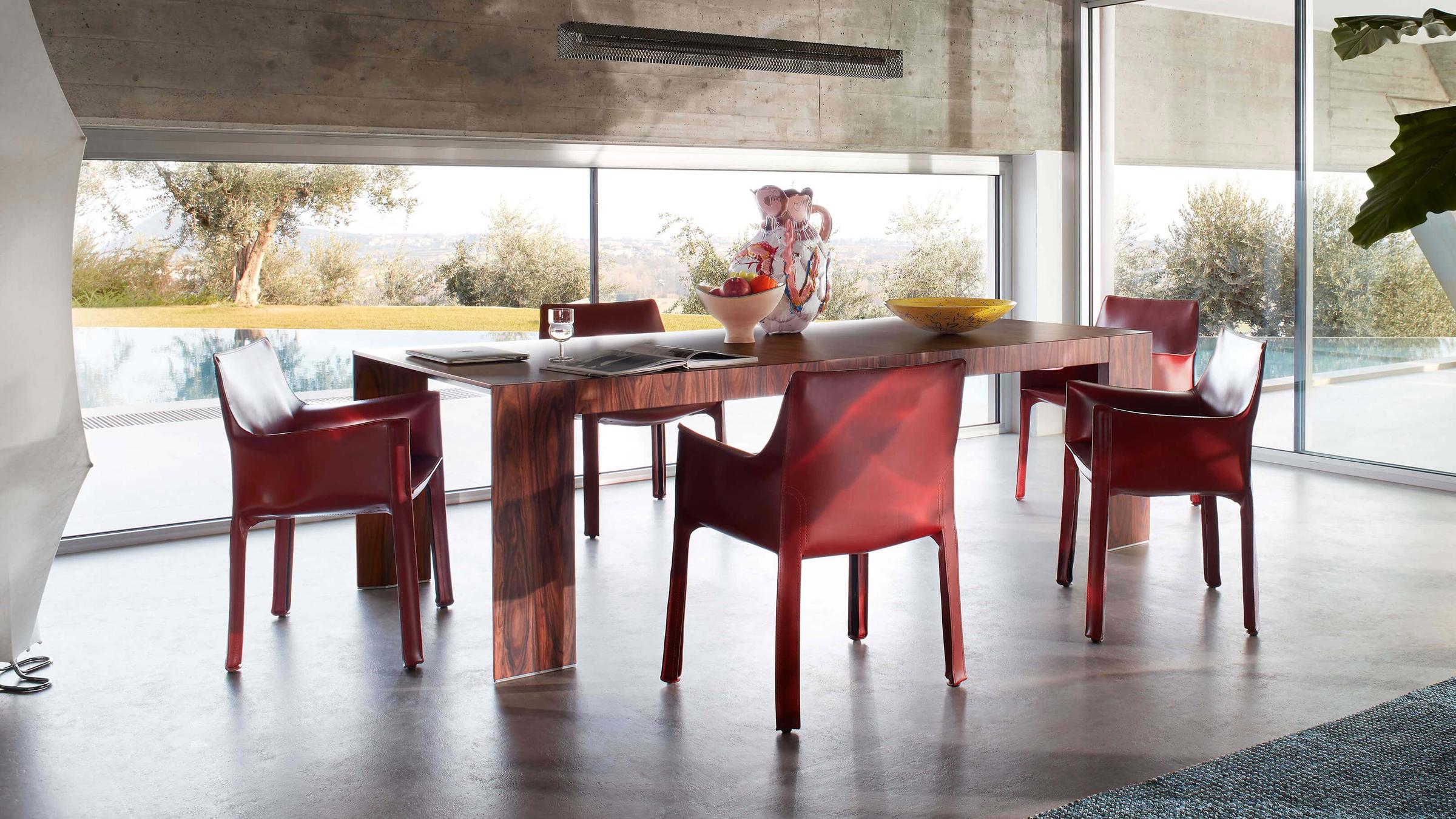
The Cassina Cab Armchair arrived in 1977 as a quiet but definitive rupture in Italian furniture design. Mario Bellini did not simply rethink upholstery. He inverted the entire relationship between a chair's structure and its surface, assigning the leather a role it had never held before. The result was not a chair with leather on it. It was a chair that was, in the most literal sense, leather.
By the mid-1970s, Bellini had already established himself as one of Italy's most analytically rigorous designers. His practice moved between architecture, product design, and industrial methodology with an ease that was rare even in Milan's dense creative milieu. He thought in systems. Where many of his contemporaries pursued visual provocation, Bellini pursued structural honesty, the idea that a form should be legible as a direct consequence of its making.
The decade itself was charged with material inquiry. Italian modernism in the 1970s was not a single movement but a contested field, with designers pulling in opposing directions: toward soft, body-responsive forms on one side, and toward geometric, industrially derived clarity on the other. Bellini operated in the tension between those poles. He was drawn to the organic, but he disciplined it with precision. The Cab Armchair crystallized that sensibility into a single object.
His broader body of work for Cassina consistently returned to this question: how does material logic generate form, rather than receive it? The Cab was where that question produced its most concentrated answer.
The defining innovation of the Cab is architectural in character. A steel tube frame, spare and angular, provides the internal armature. Over it, panels of thick saddle leather are pulled taut and zipped into place along concealed seams. The leather does not drape. It does not pad. It tensions across the frame, contributing actively to the chair's rigidity and determining its final silhouette.

The saddle stitching visible at the seams is not decorative embellishment. It is functional: the stitching holds the leather panels together and distributes tension across the surface. This is a technique borrowed from equestrian leatherwork, from a tradition of making objects that must bear load, resist wear, and maintain their geometry over years of use. Bellini did not import that tradition as an aesthetic reference. He imported its logic.
The zipper is the detail that most clearly announces the chair's conceptual departure from conventional upholstery. In standard furniture production, upholstery is applied to a frame, often permanently, often with layers of foam and fabric that obscure the underlying structure. In the Cab, the zipper makes the skin removable and replaceable, while also declaring the method of assembly openly. It is a gesture of industrial transparency: the chair shows you how it is made.
This approach placed the Cab in dialogue with industrial design practice rather than furniture tradition. Bellini was thinking about the relationship between a shell and a chassis, a logic closer to product engineering than to the upholsterer's workshop. The leather became the chair's body in the same way that a casing becomes the body of a precision instrument.
Seen in plan and elevation, the Cab Armchair holds its geometry with unusual discipline. The seat plane is level and firm. The backrest rises at a controlled angle, neither reclined nor rigidly vertical. The armrests extend as clean horizontal members, their profile consistent from shoulder to terminus. There is no swelling, no excess volume. Each plane reads as an intentional decision.

The curvature that does appear in the Cab is not expressive. It is functional, the minimum radius needed to wrap the leather around the frame's corners without stress fractures. Bellini did not impose softness for visual warmth. The curvature arrived as a consequence of material behavior, and he preserved it exactly as the material required.
This is the discipline that separates the Cab from chairs that simply look minimal. Minimalism, as it was often practiced, reduced visual complexity while leaving structural logic largely unchanged. Bellini reduced both simultaneously, and in doing so arrived at a form of volumetric economy where every surface does exactly one thing.
The Cab Side Chair, the companion piece to the armchair, extends the same logic into a lighter, more linear profile. Taken together, the two pieces constitute a coherent system, not a family of variations but a single proposition expressed at two scales.
The Cab Armchair entered the permanent collection of the Museum of Modern Art in New York, among others, within years of its introduction. That institutional recognition reflected something beyond quality of production. It reflected the chair's status as a proposal, a rethinking of what leather could mean and do in manufactured furniture.
Before the Cab, leather in furniture functioned primarily as surface material: supple, rich in association, applied over internal structures that did the actual work. Saddle leather had a longer history as a structural material in objects like luggage, harnesses, and equestrian equipment, but its translation into domestic furniture had not been pursued with Bellini's systematic commitment. The Cab redefined the category.
That redefinition drew a line between artisanal leatherwork and industrial production, and then deliberately stood on both sides of it. The saddle-stitching and the material itself carried the weight of a long artisanal lineage. The zippered assembly and the steel frame belonged to industrial methodology. Bellini did not treat these as contradictions to be resolved. He treated them as complementary registers of the same object.
Cassina's broader catalog has always operated this way, holding heritage and invention in productive tension. The LC 1 Sling Chair by Le Corbusier, Pierre Jeanneret, and Charlotte Perriand, and the Capitol Complex Chair by Pierre Jeanneret, both carry that same dual identity: objects produced by industrial means that nonetheless retain the specificity of a particular hand and a particular moment. The Cab belongs to that lineage without being reducible to it.
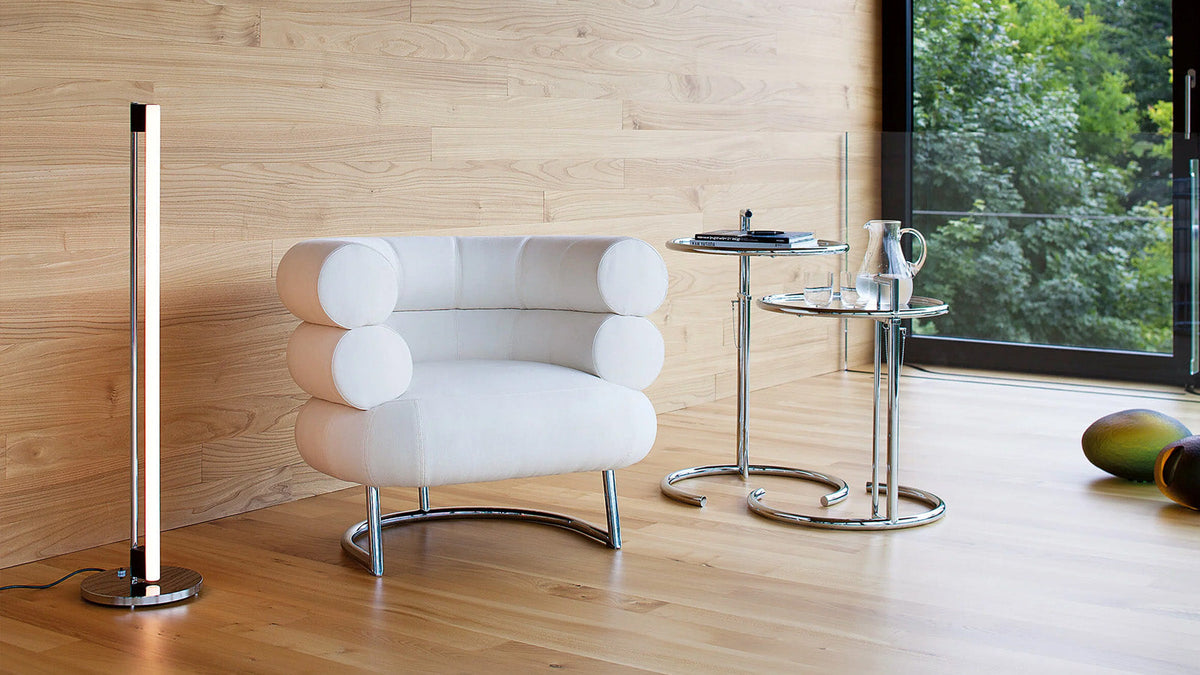
Elsewhere in the canon of 20th-century seating, the Cab's peers are few. Eileen Gray's Bibendum Armchair similarly elevated a material decision to a structural principle. Gerrit Rietveld's Zig Zag Chair made construction logic the visible subject of the design. These are chairs that argue a position. The Cab argues its position through leather.
Nearly five decades after its introduction, the Cab Armchair retains a presence in serious interiors that has nothing to do with nostalgia. Its proportions are compact without being diminutive. It holds its geometry in rooms of almost any architectural character, whether that room is spare and white or dense with material and pattern.

The saddle leather develops a patina over time that few materials in furniture production can rival. It does not deteriorate. It accumulates. Creases form at the seams where the leather flexes under use, deepening the stitching's visual definition. The surface shifts in tone as oils transfer and light falls differently across a softened grain. The chair at twenty years is a different object than the chair at two, and both are correct versions of what Bellini designed.
This capacity for honest aging is rare in contemporary production, where materials are often selected for their resistance to change rather than their responsiveness to it. The Cab was designed for a different philosophy: that an object should earn its identity through use, not preserve a fixed appearance against it.
For architects and interior designers working at the intersection of material specificity and formal discipline, the Cab remains a primary reference. It can be placed with a LC6 Table in a rigorously modernist interior or alongside the warmer grain of the Ventaglio Table by Charlotte Perriand without losing coherence. Its neutrality is earned, not imposed.
Trade professionals working with pieces of this caliber are welcome to explore the Trade Program, which provides access to the full depth of the catalog. Those pursuing a specific installation can begin a conversation through the Design Concierge, where project guidance is available from the first consideration through to final placement.
Bellini once described his process as a search for form that could not have been otherwise. The Cab Armchair is that search made concrete, a chair whose every surface was arrived at, not applied.
Luminaire at Design West Hollywood 2026
Design West Hollywood 2026 celebrated creativity, connection, and contemporary design, with Luminaire Los Angeles and Arclinea Los Angeles hosting memorable gatherings that brought the design community together.
In Conversation with Sophie Goineau
Interior architect Sophie Goineau designs across scales, from a single object to the architecture around it and the land beyond. She discusses composing interiors as one continuous experience, letting each place and its people shape a project's language, and her work on Selby Lane with the San Francisco team.
Charlotte Perriand's Tabouret Stools: Alpine Form, Modern Use
Read moreabout Charlotte Perriand's Tabouret Stools: Alpine Form, Modern Use
Inside Luminaire Chicago: Italian Design in River North Since 1989
Read moreabout Inside Luminaire Chicago: Italian Design in River North Since 1989
Eileen Gray's E 1027 Table: A Design Conceived for Living
Read moreabout Eileen Gray's E 1027 Table: A Design Conceived for Living
LC14 Tabouret Cabanon: Le Corbusier's Smallest Architecture
Read moreabout LC14 Tabouret Cabanon: Le Corbusier's Smallest Architecture
Sacco Chair by Zanotta: The 1968 Object That Refused to Be Furniture
Read moreabout Sacco Chair by Zanotta: The 1968 Object That Refused to Be Furniture
Inside Luminaire Coral Gables: The Showroom and Its Design Services
Read moreabout Inside Luminaire Coral Gables: The Showroom and Its Design Services
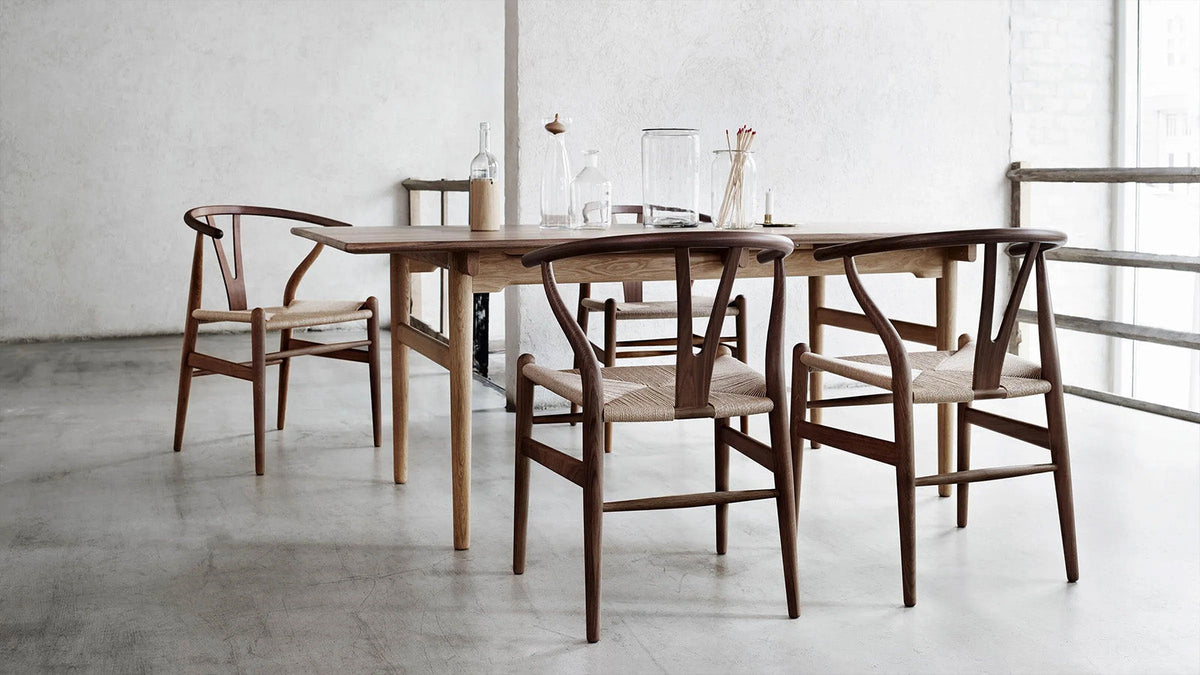
The Wishbone Chair: Hans Wegner's CH24 and the Art of Making
Read moreabout The Wishbone Chair: Hans Wegner's CH24 and the Art of Making
Cassina Chairs - The Collectors' Guide
Few furniture makers have shaped the chair as a cultural object the way Cassina has. From their earliest collaborations with the European avant-garde to their ongoing stewardship of the twentieth century's most consequential seating designs, the Meda-based manufacturer remains the standard against which Italian furniture brands are measured. This guide surveys the Cassina chairs we carry and the ideas embedded in each one.
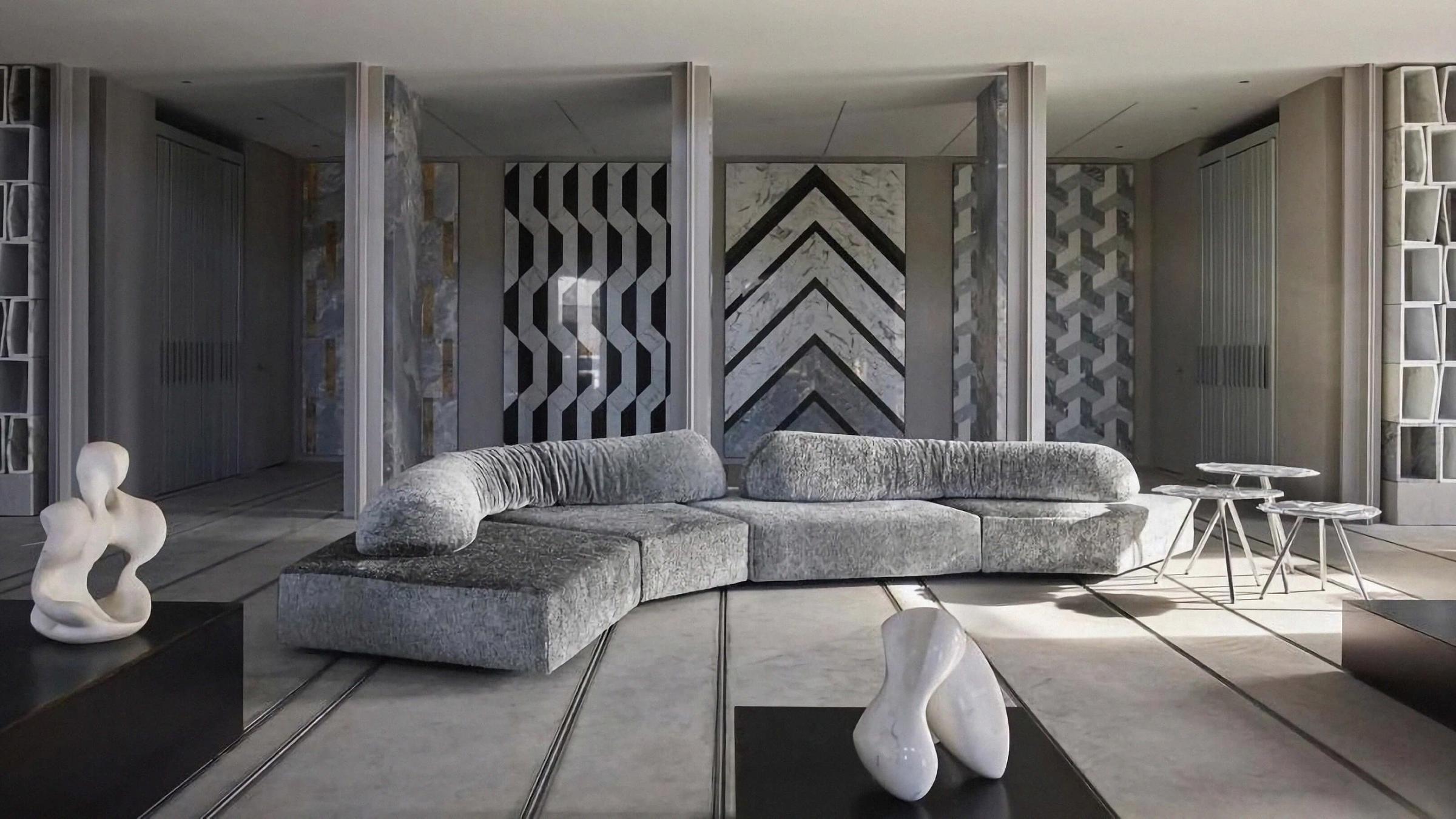
On the Rocks by Edra: Francesco Binfaré's Geology of Rest
Read moreabout On the Rocks by Edra: Francesco Binfaré's Geology of Rest
The 14p Portable Lamp: Bocci's Cast-Glass Sphere, Untethered
Read moreabout The 14p Portable Lamp: Bocci's Cast-Glass Sphere, Untethered
Our design services cover everything from concept development to installation, including product guidance, material selection, custom configurations, pricing, and lead‑time coordination.
Speak with a Design Consultant
Call 855-341-3620 for assistance during business hours.
Enroll for privileged access to iconic design, emerging trends, exclusive events, and thoughtfully curated offers.



Share:
The Hiroshima Chair: Naoto Fukasawa's Continuous Gesture in Wood
A Gesture of Gratitude: Milan Design Week 2026