
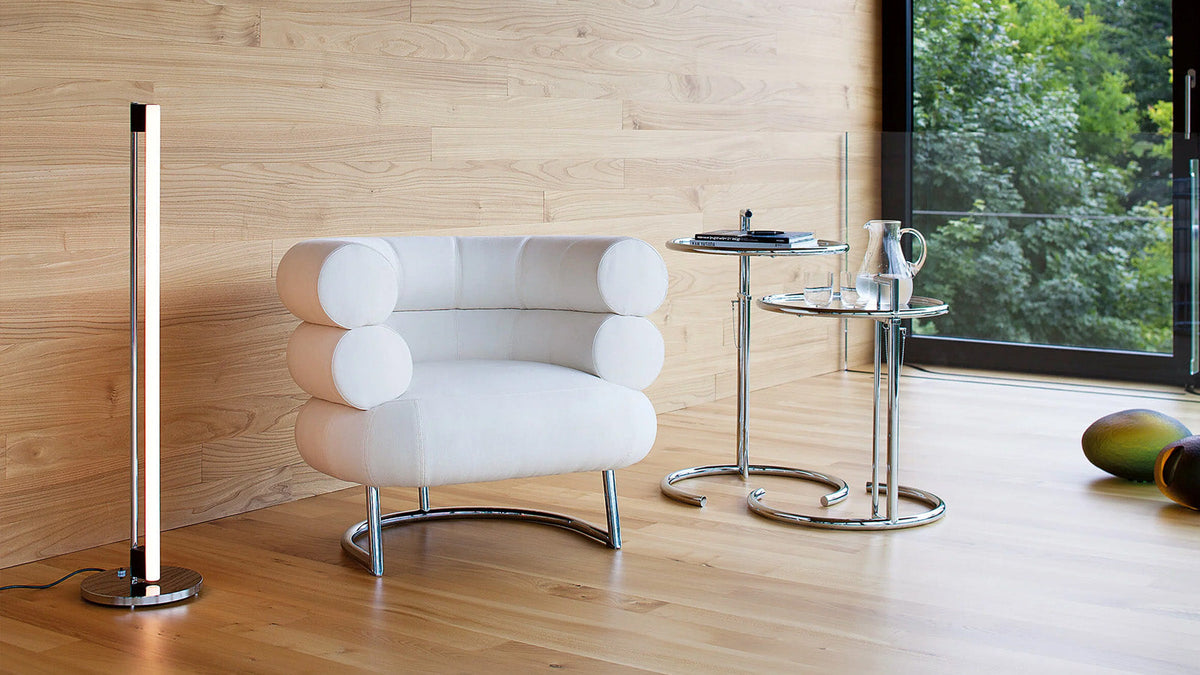
The eileen gray side table begins not in a factory or a design studio, but on a steep site above Roquebrune-Cap-Martin, where a self-taught architect named Eileen Gray spent three years building the house she had always wanted to live in. Villa E-1027, completed in 1929, was named with the coded initials of Gray and her companion Jean Badovici: E for Eileen, 10 for J (the tenth letter), 2 for B, 7 for G. Every object inside it was considered at the same resolution as the architecture. The table that would carry her name was one of them.
Gray was 49 when she finished the villa. She had come to architecture through furniture, through lacquer work learned from Japanese craftsmen in Paris, through rug design and interior commissions that placed her at the edge of the European avant-garde without placing her inside it. The E 1027 table arrived in 1927, two years before the villa was complete, already formed in her thinking as something specific: a surface that could swing over a bed frame so that a guest could take breakfast without sitting up.
The Côte d'Azur in the late 1920s was a particular kind of laboratory. Le Corbusier was building nearby; Jean Prouvé was working through similar problems of steel and mobility in Nancy. Gray was doing something different. Her interiors were warmer, more attuned to the body's actual demands, less interested in declaring a program than in solving for comfort with structural honesty.
The E 1027 table is the clearest expression of that difference. Its base is a single tubular steel stem fixed to a weighted foot with small casters, and from that stem a cantilevered arc extends horizontally, terminating in a circular top. The arc is the essential move. It means the table can slide over the arm of a sofa or beneath the overhang of a bed frame, placing the surface exactly where the user needs it without requiring the user to move toward it. The adjustment mechanism, a key-lock collar on the stem, holds the top at any chosen height between roughly 65 and 90 centimeters. You raise it, turn the key, and it stays.

What Gray understood, and what the table proves, is that adjustability is not a concession to function. It is a form of hospitality. The table does not ask the person to adapt. That inversion, quiet and structural, is what makes the E 1027 table something other than period furniture. It describes a relationship between object and body that most furniture design still does not achieve.
Gray's story is one of the more uncomfortable episodes in the history of modernism's self-mythology. She was well regarded in Parisian circles during the 1920s, but the E-1027 villa was systematically appropriated in ways that erased her authorship. Le Corbusier painted murals on its walls without her permission, and for decades his presence on that coast overshadowed hers. When the villa was documented, it was often attributed primarily to Badovici. Gray, who outlived most of her contemporaries by two decades, dying in Paris in 1976 at age 98, watched her work drift from the canon and return only slowly.
The reappraisal gathered force in the 1970s, when a 1972 auction of her furniture in Paris drew international attention and prices no one had anticipated. Collectors and historians began reconstructing what had been overlooked. The E 1027 table was reissued with her involvement and blessing. She is now recognized as one of the few women of the early modern movement whose biography is searched by name, whose work is sought by those who understand its context rather than those following a decorator's checklist.
That recognition changes how the table reads in a room. It carries a specific history, a specific argument about whose contributions were recorded and whose were not. Placing it is not neutral.
The edition carried today is produced by Classicon, the Munich-based manufacturer authorized through a license held by Aram Designs Ltd of London. The licensing lineage matters. Aram, founded by Zeev Aram, has been the primary guardian of Gray's reissued designs since the 1970s and holds the documentation to verify production continuity. An authorized edition carries that provenance in a way a copy cannot.

The frame is available in chrome or in a matte black powder-coat finish. Chrome reads as the original specification: bright, slightly industrial, catching light at the arc's bend. The black finish recedes, placing emphasis on the geometry rather than the surface. Both are formed from tubular steel with the proportions Gray established: a stem diameter and arc radius that look right from every angle because they were drawn to be structurally legible at human scale, not oversized for visual drama.
The top is clear glass in both configurations, a circular disc whose transparency reinforces the cantilevered logic. You can see the floor through it, which means the table never reads as heavy. In small rooms, that optical lightness matters considerably.
The Adjustable Table E 1027 carries the Classicon mark and Aram licensing documentation. Copies, which exist in considerable volume at lower price points, typically differ in the stem proportions, the key-lock collar detail, and the foot weight distribution. A table with an undersized stem or a lock mechanism that slips under load is not reproducing the design. It is reproducing the silhouette.
The cantilever is the primary practical argument. Most side tables require clearance beside the sofa or bed frame; the E 1027 requires clearance only at the foot or side where it approaches. The arc swings over the arm, positioning the top above the seat or mattress surface. For a reading chair set against a wall, or a bed in a narrow room where a conventional nightstand would block passage, this distinction is not aesthetic. It is the difference between a table that fits and one that does not.
The height range, spanning roughly the low side of sofa-arm height to above standard desk height, accommodates the table beside a low platform bed, at seated elbow height for a task, or raised above a high mattress for someone working against a stack of pillows. The adjustment takes seconds. For anyone who works from bed, reads in a chair that is not at standard height, or simply wants the surface to meet them rather than be met, the mechanism is not a feature. It is the design.
Beside a sofa, the chrome finish reads well against warm-toned upholstery, where the contrast between steel and textile is part of the composition. Against white or pale linen, the black finish creates a more deliberate graphic note. The glass top is compatible with either approach because it introduces no color of its own.

The casters at the base allow the table to be repositioned without lifting, which is a detail that reads as minor until the moment it becomes essential. Gray included them in 1927 not as a convenience but as an extension of the same logic that informs the whole: furniture should move when the person needs it to move.
The market for Gray reproductions is substantial, and the E 1027 table is among the most copied objects in twentieth-century furniture design. At a glance, the differences between an authorized Classicon edition and an unlicensed copy can seem minor. They are not.
In an authorized edition, the stem diameter follows the original specification and is consistent top to bottom. In most copies, the stem is thinner or tapered in ways that alter the visual weight of the piece against its own foot. The key-lock collar, the collar that tightens against the stem to hold the chosen height, should be smooth, machine-finished, and positive in operation. Collars that require significant force to release, or that drift under the weight of a full glass, are indicating a tolerance gap that the original design does not have. The foot weight should prevent any rocking when the top is extended at full height and under load; an undersized foot creates a lever problem that the original proportions resolve by distributing mass correctly.
Documentation from Classicon and the Aram license provides the authentication layer that resale markets recognize. For those approaching the piece as a long-term acquisition rather than a short-term furnishing decision, the authorized edition is the only version that carries that continuity. Interior designers working on projects where provenance documentation is required will find the chain of authorization relevant. The Trade Program offers dedicated support for project-scale acquisitions of this kind.
Gray was precise about things. She was precise about her architecture, her lacquerwork, her rugs, and her furniture. The E 1027 table has survived nearly a century not because it is simple, though it is, but because its proportions were correct from the start and its function remains unresolved by anything that came after it.
In Conversation with Sophie Goineau
Interior architect Sophie Goineau designs across scales, from a single object to the architecture around it and the land beyond. She discusses composing interiors as one continuous experience, letting each place and its people shape a project's language, and her work on Selby Lane with the San Francisco team.
Charlotte Perriand's Tabouret Stools: Alpine Form, Modern Use
Read moreabout Charlotte Perriand's Tabouret Stools: Alpine Form, Modern Use
Inside Luminaire Chicago: Italian Design in River North Since 1989
Read moreabout Inside Luminaire Chicago: Italian Design in River North Since 1989
Eileen Gray's E 1027 Table: A Design Conceived for Living
Read moreabout Eileen Gray's E 1027 Table: A Design Conceived for Living
LC14 Tabouret Cabanon: Le Corbusier's Smallest Architecture
Read moreabout LC14 Tabouret Cabanon: Le Corbusier's Smallest Architecture
Sacco Chair by Zanotta: The 1968 Object That Refused to Be Furniture
Read moreabout Sacco Chair by Zanotta: The 1968 Object That Refused to Be Furniture
Inside Luminaire Coral Gables: The Showroom and Its Design Services
Read moreabout Inside Luminaire Coral Gables: The Showroom and Its Design Services
The Wishbone Chair: Hans Wegner's CH24 and the Art of Making
Read moreabout The Wishbone Chair: Hans Wegner's CH24 and the Art of Making
Cassina Chairs - The Collectors' Guide
Few furniture makers have shaped the chair as a cultural object the way Cassina has. From their earliest collaborations with the European avant-garde to their ongoing stewardship of the twentieth century's most consequential seating designs, the Meda-based manufacturer remains the standard against which Italian furniture brands are measured. This guide surveys the Cassina chairs we carry and the ideas embedded in each one.
On the Rocks by Edra: Francesco Binfaré's Geology of Rest
Read moreabout On the Rocks by Edra: Francesco Binfaré's Geology of Rest
The 14p Portable Lamp: Bocci's Cast-Glass Sphere, Untethered
Read moreabout The 14p Portable Lamp: Bocci's Cast-Glass Sphere, Untethered
The Arco Lamp: Achille Castiglioni's Arc Over Sixty Years
Read moreabout The Arco Lamp: Achille Castiglioni's Arc Over Sixty Years
Our design services cover everything from concept development to installation, including product guidance, material selection, custom configurations, pricing, and lead‑time coordination.
Speak with a Design Consultant
Call 855-341-3620 for assistance during business hours.
Enroll for privileged access to iconic design, emerging trends, exclusive events, and thoughtfully curated offers.



Share:
LC14 Tabouret Cabanon: Le Corbusier's Smallest Architecture
Inside Luminaire Chicago: Italian Design in River North Since 1989