
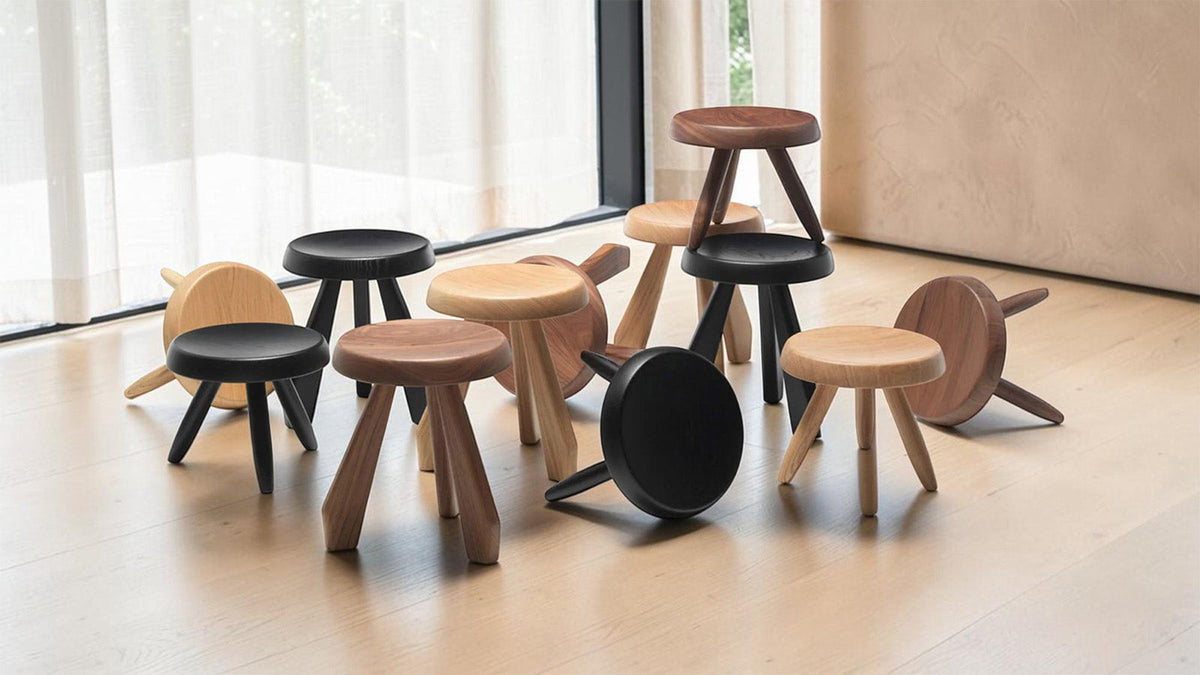
The word "tabouret" arrives in English from Old French, naming nothing more complicated than a small drum, and by extension the low cylindrical seat that resembled one. For centuries it circulated through European court life as a marker of privilege: at Versailles, the right to sit on a tabouret in the presence of the king was a formal honor, granted by rank. That history is almost entirely irrelevant to the tabouret stool as modernism inherited it. By the time Charlotte Perriand encountered the form, it had shed every courtly association and returned to something older and more useful.
Perriand's source was not historical research. It was the French Alps themselves, and the working objects she found there during her time designing communal living and leisure infrastructure in the mountains from the late 1930s onward. The simple milking stools turned by local craftsmen from regional wood carried what she later described as an indispensable rightness: three legs, a turned seat, nothing added, nothing to remove. She recognized that the anonymous makers of these objects had solved, without deliberate design intention, a problem that most furniture designers overcomplicate.
The Tabouret Stools produced by Cassina preserve that recognition. Originally designed for Perriand's own chalet and first presented in 1955, the family emerged from a sensibility she shared with her contemporaries in France and Japan: that the most persuasive modern objects are those with the shortest distance between idea and material, between need and form.

The family divides into two distinct characters, and the difference is not merely one of height. The Tabouret Berger sits close to the ground on three gently tapered, hand-turned legs. Its posture is low and unhurried. The name references the shepherd directly, and the form holds to the vernacular with discipline: the seat is round, slightly cupped at the center to receive weight, and the legs spread just enough to be stable without widening into a visual claim. At this height, the stool invites a specific kind of use, the kind that accompanies tasks rather than ceremonies.
The Tabouret Méribel, named for the ski resort Perriand helped plan, stands taller. Its tripod legs angle outward with a structural confidence that shifts the reading of the piece from rural reference to deliberate design. The silhouette is more open, the proportions more assertive. Both versions share the hand-turned seat with its subtle central depression, a detail that could easily be dismissed as vestigial but that in practice defines the object's relationship to the body. It is shaped, not merely flat. That distinction matters.

The available finishes span natural oak, American walnut, and oak stained black. Each wood reads differently against the same turned form. Natural oak keeps the connection to the Alpine vernacular intact, the grain visible, the color warm without sweetness. American walnut deepens the palette and pulls the piece closer to mid-century American craft traditions, which is an unexpected but entirely coherent dialogue for an object of French Alpine origin. The black-stained oak version is the most abstracted: at a certain light angle, the turning becomes a silhouette study, the wood receding and the form advancing.
The tabouret stool has always been a promiscuous object. Its defining characteristic, across every culture and period that has produced one, is mobility and compactness. It moves. It serves. It waits. In French interiors of the mid-twentieth century, particularly the spare, material-honest interiors that Perriand and her circle were designing, the low stool beside an armchair or at the edge of a bath performed a function that purpose-built side tables sometimes failed at: it held a book, a glass, a lamp, or a body, with equal willingness and no change in object.
That double use has a Japanese parallel that Perriand understood more directly than most of her European contemporaries. Her extended time in Japan from 1940 to 1942, consulting for the Japanese Ministry of Commerce and Trade, shaped her understanding of objects that serve more than one purpose without pretending to be something they are not. The Japanese aesthetic of objects placed low, close to the floor, and moved freely around a room reinforced what she had already intuited from Alpine working culture. The tabouret stool, whether beside a hearth or beneath a console table, is furniture that does not insist on its own permanence.
This quality makes placement less a prescription than a conversation. A Tabouret Berger beside an armchair offers a surface at exactly the right height for a cup or a folded newspaper without the visual mass of a side table. Tucked under a console in an entry hall, it disappears until it is needed. At the edge of a freestanding bath, it becomes a ledge with warmth and weight. Against a fireplace surround, it holds the tools or holds a person looking at the fire. It does all of these things without transformation, without adjustment, without asking anything of the room.

Turned wood as a process is older than almost any other furniture-making technique, and Cassina's production of the Tabouret Stools preserves its logic rather than industrializing it away. The lathe produces a form that is both precise and warm: the tool marks are controlled but the grain is unpredictable, and the subtle compression of the seat depression is only achievable by turning rather than carving or molding. The result is that no two stools are identical in the way that no two pieces of wood are identical, which is the point. Perriand was not designing a product for uniformity. She was translating an object that had been made, by hand, by people with no interest in design history, into a form that could carry that same quality forward.
Among the stool designs that Cassina has preserved from the twentieth century, the Tabouret family occupies a specific position. It is neither the most assertively modern nor the most decoratively complex object in the catalogue. That restraint is its argument. Perriand did not need the stools to announce themselves. She needed them to be present, useful, and honest about what they were made from and how.
The current conversation around interiors, particularly among those who take seriously the relationship between objects and rooms, has moved toward pieces that resist easy categorization. A chair that reads only as a chair, a table that reads only as a table: these are increasingly insufficient. The tabouret stool, in either of Perriand's versions, has no such limitation. Its ambiguity is structural, not stylistic.
In a bedroom, a pair of Tabouret Berger stools at the foot of the bed replaces the conventional bench without announcing the substitution. In a bathroom, the Méribel's taller stance suits the edge of a stone bath or a vanity stool position with more presence than the Berger's low form. In an open living space, a stool placed beside a low sofa does not need to match the coffee table to belong there. It belongs because it is made from wood and turned on a lathe and shaped to receive weight, which is a description that fits the history of almost every interior tradition worth caring about.
Explore the full range of contemporary stool designs to place these alongside other considered small-seat objects in your interior.
Charlotte Perriand's Tabouret Stools: Alpine Form, Modern Use
Read moreabout Charlotte Perriand's Tabouret Stools: Alpine Form, Modern Use
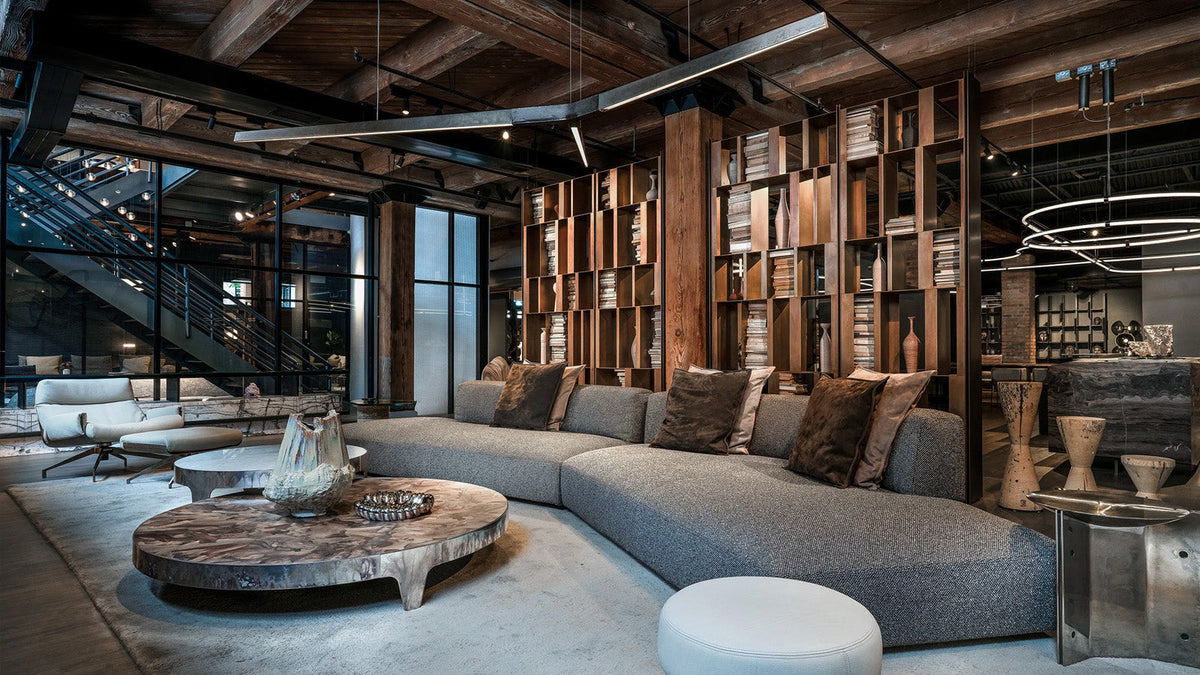
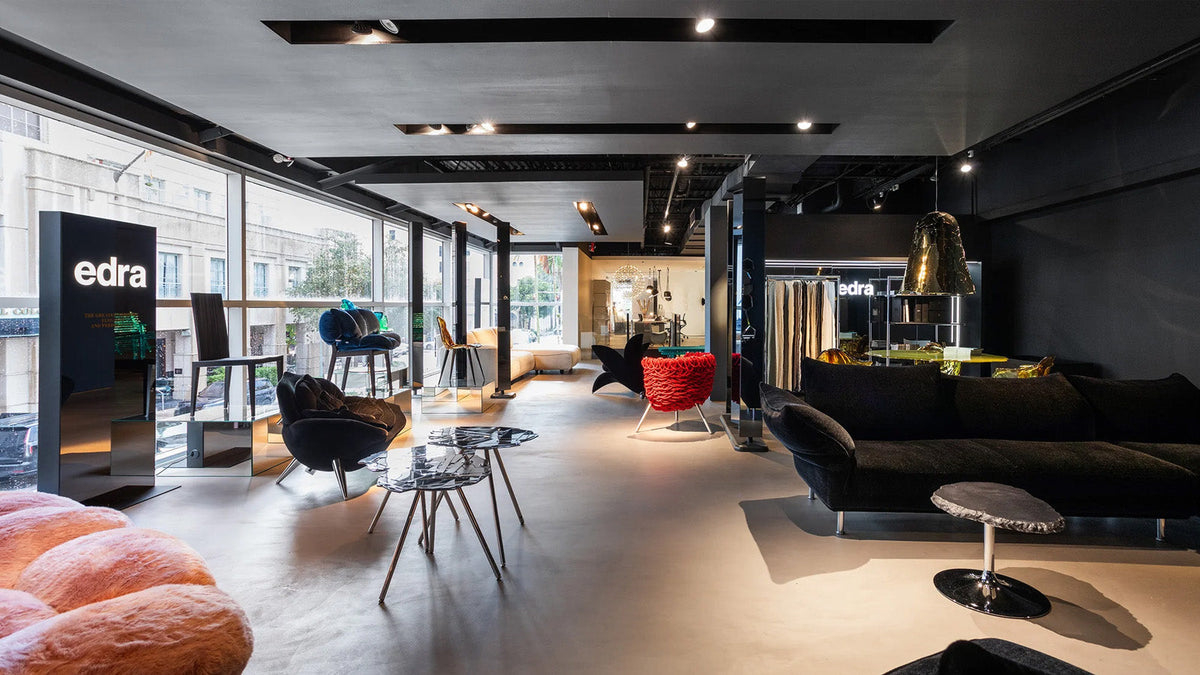
Inside Luminaire Chicago: Italian Design in River North Since 1989
Read moreabout Inside Luminaire Chicago: Italian Design in River North Since 1989
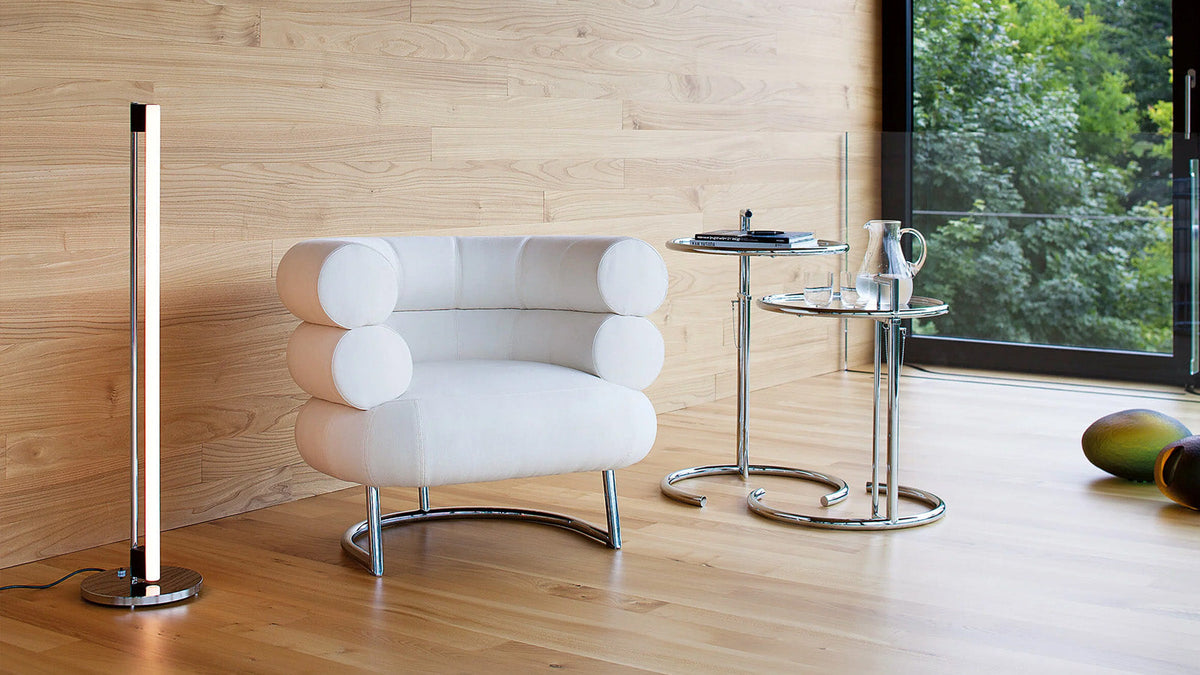
Eileen Gray's E 1027 Table: A Design Conceived for Living
Read moreabout Eileen Gray's E 1027 Table: A Design Conceived for Living
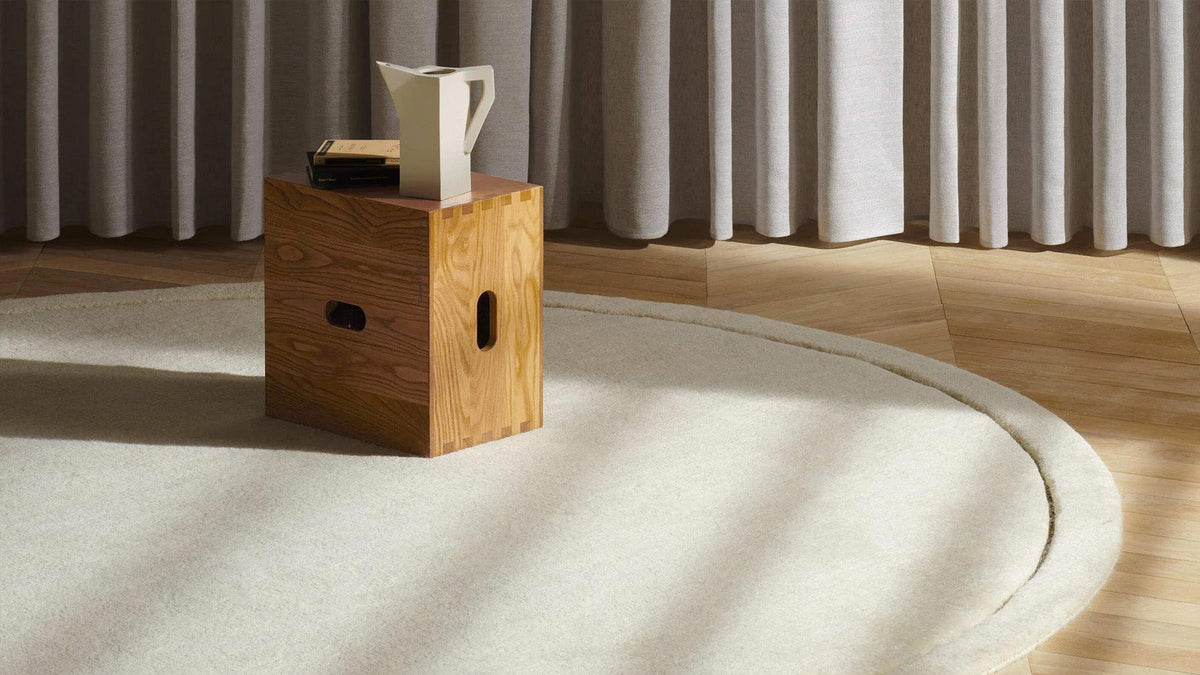
LC14 Tabouret Cabanon: Le Corbusier's Smallest Architecture
Read moreabout LC14 Tabouret Cabanon: Le Corbusier's Smallest Architecture
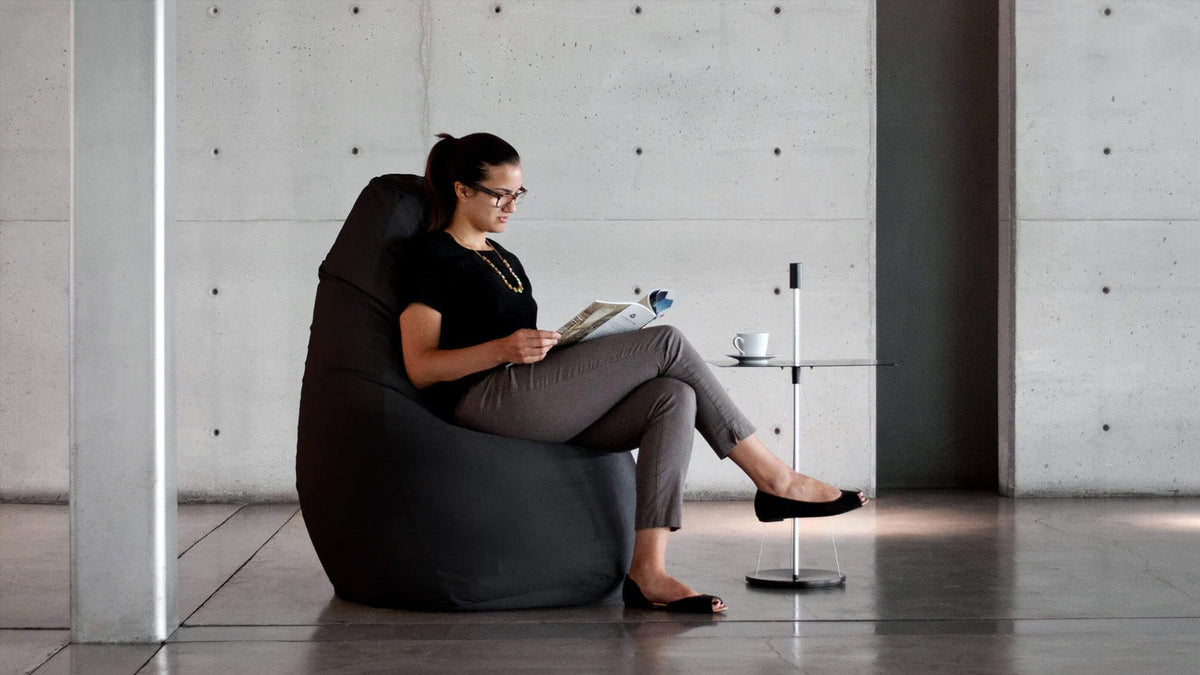
Sacco Chair by Zanotta: The 1968 Object That Refused to Be Furniture
Read moreabout Sacco Chair by Zanotta: The 1968 Object That Refused to Be Furniture
Inside Luminaire Coral Gables: The Showroom and Its Design Services
Read moreabout Inside Luminaire Coral Gables: The Showroom and Its Design Services
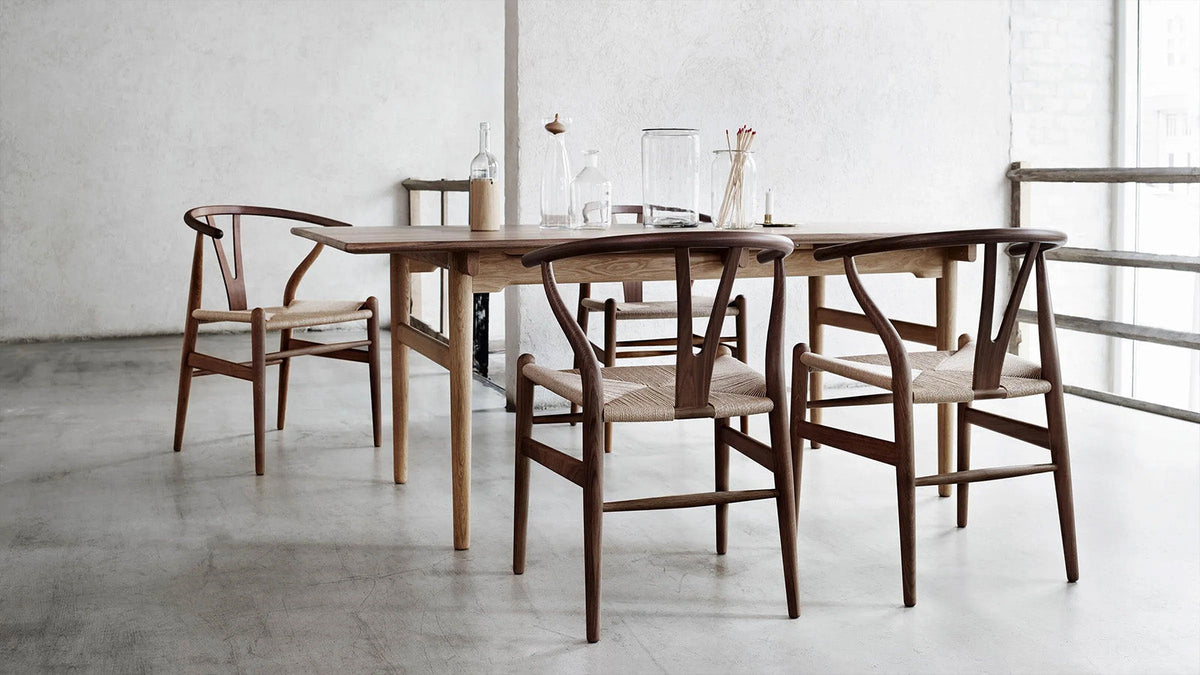
The Wishbone Chair: Hans Wegner's CH24 and the Art of Making
Read moreabout The Wishbone Chair: Hans Wegner's CH24 and the Art of Making
Cassina Chairs - The Collectors' Guide
Few furniture makers have shaped the chair as a cultural object the way Cassina has. From their earliest collaborations with the European avant-garde to their ongoing stewardship of the twentieth century's most consequential seating designs, the Meda-based manufacturer remains the standard against which Italian furniture brands are measured. This guide surveys the Cassina chairs we carry and the ideas embedded in each one.
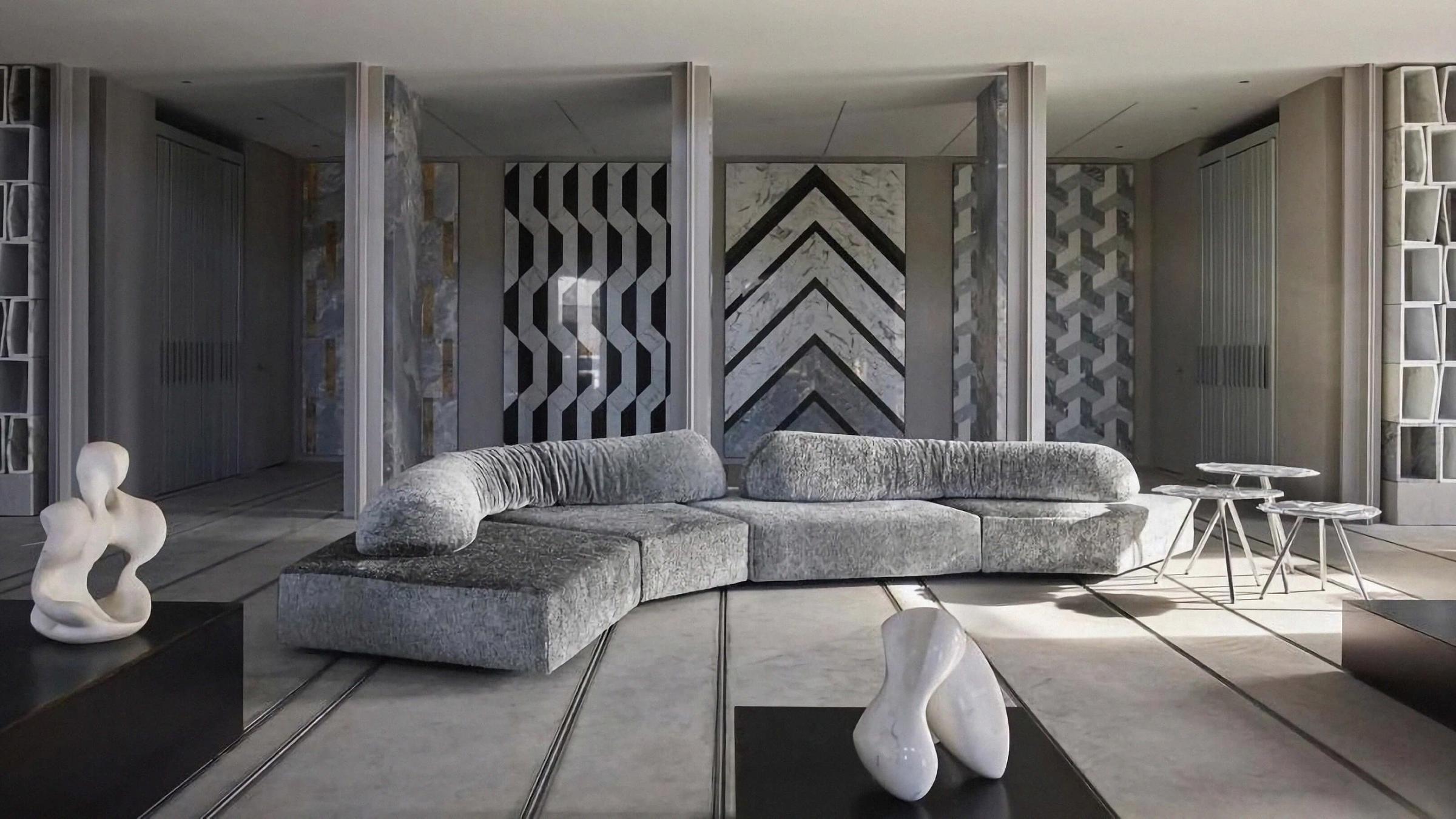
On the Rocks by Edra: Francesco Binfaré's Geology of Rest
Read moreabout On the Rocks by Edra: Francesco Binfaré's Geology of Rest
The 14p Portable Lamp: Bocci's Cast-Glass Sphere, Untethered
Read moreabout The 14p Portable Lamp: Bocci's Cast-Glass Sphere, Untethered
The Arco Lamp: Achille Castiglioni's Arc Over Sixty Years
Read moreabout The Arco Lamp: Achille Castiglioni's Arc Over Sixty Years
Henge Finds a New Home in Chicago at Luminaire
During NeoCon 2026, we welcomed Henge into our Chicago showroom, marking a new chapter in the brand’s growing presence in the United States.
Read moreabout Henge Finds a New Home in Chicago at Luminaire
Our design services cover everything from concept development to installation, including product guidance, material selection, custom configurations, pricing, and lead‑time coordination.
Speak with a Design Consultant
Call 855-341-3620 for assistance during business hours.
Enroll for privileged access to iconic design, emerging trends, exclusive events, and thoughtfully curated offers.




Share:
Inside Luminaire Chicago: Italian Design in River North Since 1989