
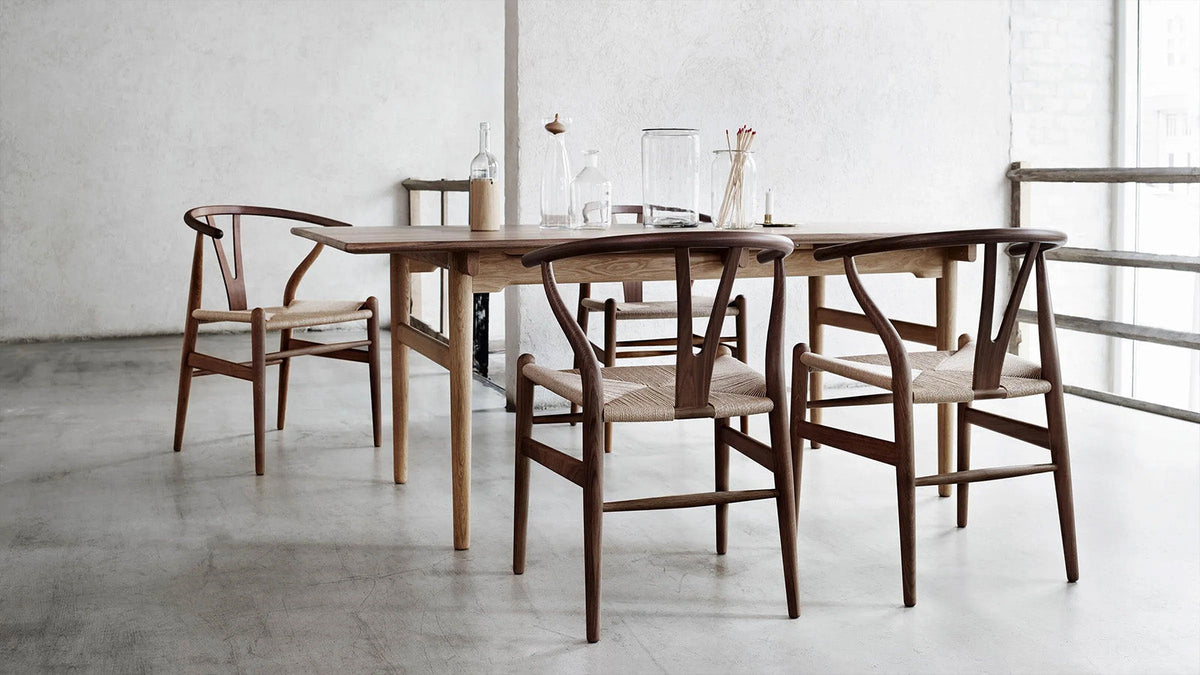
The wishbone chair arrived in 1949 as the last in a sequence of chairs Hans J. Wegner derived from portraits of Danish merchants seated in Ming-dynasty chairs. Where his earlier studies in that series retained heavier proportions, the CH24 shed every excess. The Y-shaped back, from which the popular name derives, is both a structural solution and an image: it resolved the challenge of supporting the spine without crowding the sitter, and it gave the chair a silhouette recognizable at any angle. Carl Hansen & Søn began producing it in 1950, and has not stopped since.
Continuity of that length is uncommon in furniture. It signals something beyond sentiment. The form is genuinely right, and the manufacturing relationship between design and maker has proven durable enough to absorb changing tastes, material sourcing challenges, and shifts in how people use a dining chair across generations.
Wegner began his systematic study of Chinese chairs in the 1940s, working from painted portraits in Danish collections that depicted Sino-Danish traders seated in high-backed Ming chairs. Those originals shared a structural logic: curved, continuous top rails bridged into vertical splats, distributing load across the back while keeping the frame visually open. Wegner translated that logic into a Danish idiom, pairing it with the materials and workshop traditions he knew from his training as a cabinetmaker in Jutland.
The CH24 was the fourth chair in this Ming-derived series. By that point, Wegner had refined the proportions to their minimum. The top rail is bent from a single piece of solid wood, steam-formed into a continuous curve that arcs across the sitter's upper back without interruption. The Y-splat below it is not decorative. It triangulates the rail against the seat, stiffening the back without the weight a full panel would require. The chair is light enough to lift with two fingers. It is also, under load, entirely rigid.

Each wishbone chair passes through more than 100 individual production steps at the Carl Hansen & Søn workshops in Gelsted, Denmark. The process begins with the selection and kiln-drying of solid wood, followed by milling the component parts to precise tolerances. The top rail, the chair's most visually defining element, is soaked and then bent under steam pressure into its continuous arc. Steam-bending of solid wood requires the grain to run cleanly through the curve without short-fibering, so species selection and stock orientation both matter. A single defect in the grain can cause a rail to crack under tension during bending or fail years later under cyclic load.
The joints are mortise-and-tenon throughout, glued and assembled by hand. Carl Hansen production has always relied on this traditional joinery for the simple reason that it holds. Dowel joints and metal fasteners respond poorly to the seasonal wood movement that Scandinavian humidity cycling demands. Mortise-and-tenon construction allows the chair to flex incrementally without loosening.
The paper cord seat is where the production becomes genuinely extraordinary. A trained weaver works through approximately 120 meters of cord per chair, executing a precise diagonal pattern that distributes load evenly across the seat frame. Paper cord, made from twisted kraft paper, was Wegner's material of choice for the same reason Scandinavian folk furniture had long used rush and cord: it is light, breathable, and gains a particular surface quality through use. The weave pattern is not simply aesthetic. The diagonal orientation transfers stress more evenly than a rectilinear grid would, and the cord's slight give underfoot makes the chair comfortable over long periods without requiring cushioning.

Carl Hansen offers the CH24 in several wood species, each with a distinct material character. Oak is the most common, chosen for its pronounced grain, structural reliability, and availability in the quality grades the chair requires. Walnut reads darker and denser, with a tighter grain pattern that makes the bent rail appear almost lacquered even in an unfinished state. Beech and cherry are also produced, each shifting the chair's visual register considerably.
The finish choice is equally consequential. Soaped oak develops a whitened, matte surface over time as the soap deposits close the grain pores, producing a Nordic, almost bleached quality that suits pale stone and linen-heavy interiors. Oiled finishes preserve the wood's natural warmth and are the easiest to maintain at home: a periodic wipe with a small amount of furniture oil is sufficient to restore surface moisture. Lacquered finishes, available in both clear and pigmented options, seal the grain entirely and demand less upkeep, though they sacrifice some of the wood's tactile responsiveness and are harder to repair locally if scratched.
Paper cord seats age well when treated with basic care. Spills should be blotted, not rubbed, and the surface can be wiped with a damp cloth. Direct sunlight will bleach the cord over time, a patina that many owners consider appropriate to the chair's folk material heritage. When a seat finally wears through, after years or decades of daily use, Carl Hansen and authorized repair services can reweave it. The chair's frame outlasts multiple seats; the design anticipates this. It is one of the few dining chairs in continuous production where end-of-life repairability is built into the product's economic model from the start.
The CH24 works across a wider range of dining contexts than most chairs of its generation precisely because its proportions are genuinely neutral. Its seat height of 45 centimeters and its relatively low back mean it does not dominate a table visually. It reads as a chair that defers to the room rather than competing with it.
Against a rough-sawn oak farm table, the wishbone chair's cord seat and natural wood finish register as an extension of the same material culture. Against Carrara marble or polished concrete, the same chair reads differently: lighter, more considered, a deliberate softness introduced into a hard-edged setting. This flexibility is not accidental. Wegner's commitment to visible joinery and natural materials means the chair carries legible craft signals that function in both vernacular and refined contexts.
Mixing wood tones at a single table is a practice that the CH24 supports better than many chairs. Because the Y-back and seat shape are consistent across species, a dining set that combines oiled oak and walnut CH24s reads as a considered variation rather than a mismatch. The silhouette coheres even when the material does not match exactly. Designers working with the chair often use this flexibility to introduce warmth and texture variation without changing the visual grammar of the room.

The CH24 is among the most copied chairs in the modern canon. The gap between an authorized Carl Hansen production and a reproduction is not merely a matter of provenance. It is a matter of engineering and material durability.
Authentic chairs carry the Carl Hansen & Søn brand mark on the underside of the seat frame, alongside a production stamp. The joinery on genuine examples is visible at the rail-to-leg connections: the tenons are precisely fitted and the glue lines, when present at all, are minimal. Reproductions typically use dowel joints or, worse, metal brackets concealed within the leg bores, which will loosen under the rotational stress of daily chair use within a few years.
The cord weave on authentic chairs follows a specific diagonal pattern. In copies, the weave is often a simpler rectilinear grid using synthetic cord or lower-weight paper cord that feels harder underfoot and compresses unevenly. The steam-bent top rail on genuine CH24s has no seam or lamination visible along its inner curve. On copies, the bend is frequently achieved through lamination of thin strips, which is visible in the grain pattern along the rail's underside.
The full Carl Hansen & Søn collection carries this standard of production across its range, and the CH24 Wishbone Chair is produced exclusively under that name in Denmark. When considering the chair as a long-term investment in a dining room, the case for the original rests on a simple arithmetic: a reweaved seat on a frame that will hold for decades versus a replacement chair purchased every few years.
Wegner's broader body of work, much of it accessible through the Hans J. Wegner collection, returns repeatedly to this premise: that a well-made chair should not be replaced. The CH24 has had 75 years to prove the point.
Luminaire at Design West Hollywood 2026
Design West Hollywood 2026 celebrated creativity, connection, and contemporary design, with Luminaire Los Angeles and Arclinea Los Angeles hosting memorable gatherings that brought the design community together.
In Conversation with Sophie Goineau
Interior architect Sophie Goineau designs across scales, from a single object to the architecture around it and the land beyond. She discusses composing interiors as one continuous experience, letting each place and its people shape a project's language, and her work on Selby Lane with the San Francisco team.
Charlotte Perriand's Tabouret Stools: Alpine Form, Modern Use
Read moreabout Charlotte Perriand's Tabouret Stools: Alpine Form, Modern Use
Inside Luminaire Chicago: Italian Design in River North Since 1989
Read moreabout Inside Luminaire Chicago: Italian Design in River North Since 1989
Eileen Gray's E 1027 Table: A Design Conceived for Living
Read moreabout Eileen Gray's E 1027 Table: A Design Conceived for Living
LC14 Tabouret Cabanon: Le Corbusier's Smallest Architecture
Read moreabout LC14 Tabouret Cabanon: Le Corbusier's Smallest Architecture
Sacco Chair by Zanotta: The 1968 Object That Refused to Be Furniture
Read moreabout Sacco Chair by Zanotta: The 1968 Object That Refused to Be Furniture
Inside Luminaire Coral Gables: The Showroom and Its Design Services
Read moreabout Inside Luminaire Coral Gables: The Showroom and Its Design Services
The Wishbone Chair: Hans Wegner's CH24 and the Art of Making
Read moreabout The Wishbone Chair: Hans Wegner's CH24 and the Art of Making
Cassina Chairs - The Collectors' Guide
Few furniture makers have shaped the chair as a cultural object the way Cassina has. From their earliest collaborations with the European avant-garde to their ongoing stewardship of the twentieth century's most consequential seating designs, the Meda-based manufacturer remains the standard against which Italian furniture brands are measured. This guide surveys the Cassina chairs we carry and the ideas embedded in each one.
On the Rocks by Edra: Francesco Binfaré's Geology of Rest
Read moreabout On the Rocks by Edra: Francesco Binfaré's Geology of Rest
The 14p Portable Lamp: Bocci's Cast-Glass Sphere, Untethered
Read moreabout The 14p Portable Lamp: Bocci's Cast-Glass Sphere, Untethered
Our design services cover everything from concept development to installation, including product guidance, material selection, custom configurations, pricing, and lead‑time coordination.
Speak with a Design Consultant
Call 855-341-3620 for assistance during business hours.
Enroll for privileged access to iconic design, emerging trends, exclusive events, and thoughtfully curated offers.



Share:
Cassina Chairs - The Collectors' Guide
Inside Luminaire Coral Gables: The Showroom and Its Design Services