
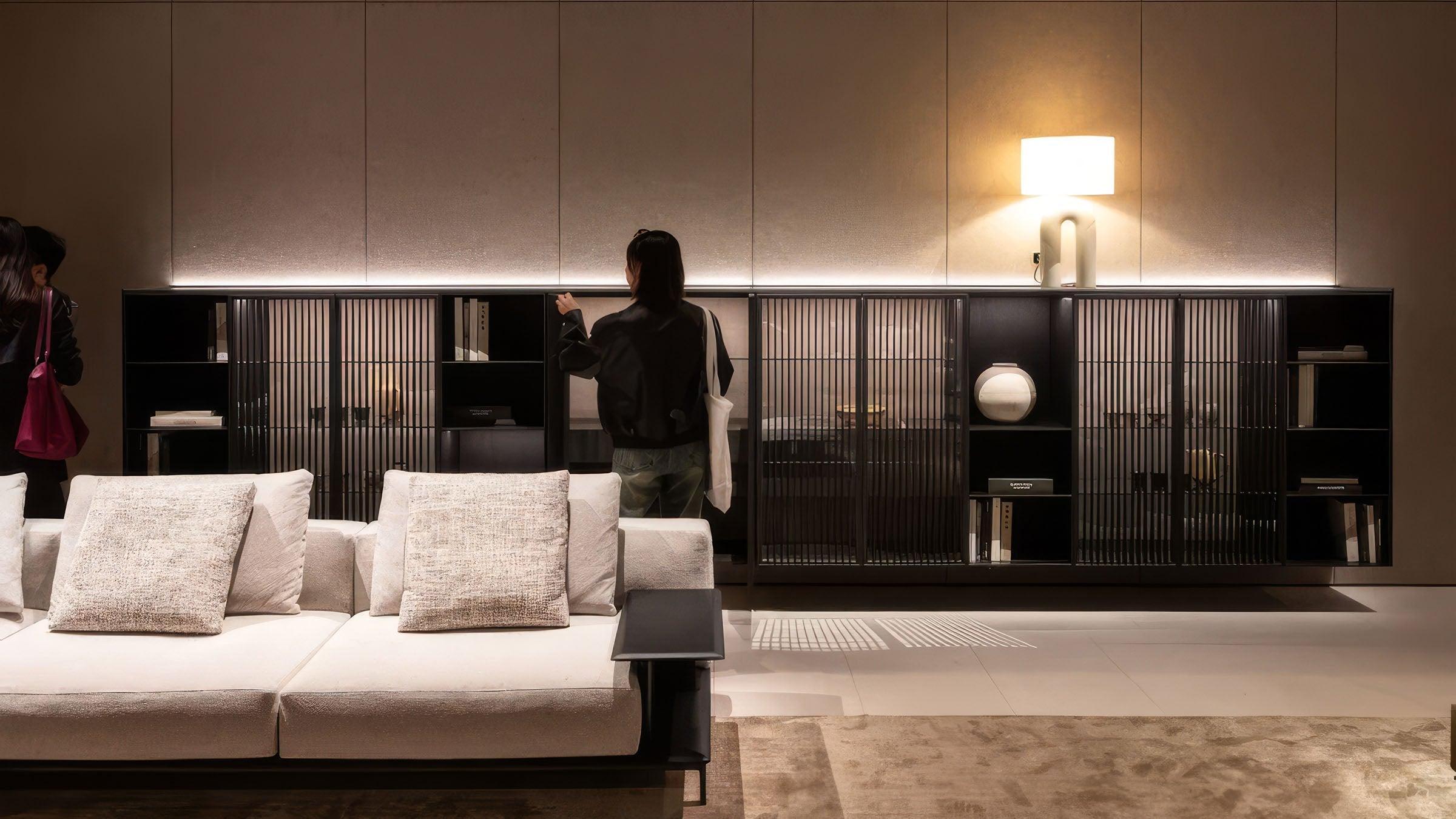
Infusing Milan with the boundless energy of dynamic forms and mind-opening concepts, the 2025 Salone del Mobile is poised to erupt with much anticipated zeal at Fiera Milano, Rho from April 8th to the 13th.
Bringing with it a symphony of cutting-edge aesthetics fused with captivating experiences, hundreds of thousands of design enthusiasts and members of the public stroll along a newly updated circular floor plan. Encountering works that engage and excite and interacting with a robust cultural program, guests embark on a journey of timelessness and multisensory events that act as an invisible bridge between the present and the future.
As we prepare to embark on a voyage of discovery at this year’s Salone del Mobile, we offer a glance inside what to expect, whose designs will set the scene, and what themes will narrate our tour of the innovative and refined.

Across the main fair, more than 2,000 exhibitors from 37 countries present spaces that redefine how design lives within the environments we inhabit. These are not static displays, but carefully composed expressions of material, form, and intention.
Luminaire’s partners are deeply embedded within this landscape, including Ambientec, Artemide, Atelier Vierkant, ClassiCon, Davide Groppi, Desalto, Edra, Flexform, Flos, Gardeco, Glas Italia, Kettal, Knoll, Living Divani, MDF Italia, Molteni & C, Porro, Santambrogio, and Sollos. Together, these voices illustrate how design shapes experience, revealing objects that resonate both visually and emotionally.
Within Pavilions 13 through 15, the section known as Luxury Way brings forward a distinctly Italian sensibility. Craftsmanship and refinement converge in objects that feel enduring yet contemporary. Elsewhere, the International Furnishing Accessories exhibition explores the expressive potential of objects that personalize a space, from textiles to sculptural accents. Workplace 3.0 and S Project extend this vision into the evolving workplace, presenting environments that respond to the rhythms of modern life.

At the heart of this year’s fair, the Euroluce Biennial returns with a renewed focus on light as both a technical medium and an emotional force. More than 300 exhibitors present lighting that shapes perception, transforming how spaces are felt as much as how they are seen.
The Light for Life forum gathers leading thinkers including Marjan van Aubel, Stefano Mancuso, Robert Wilson, Patrick Rimoux, Lonneke Gordijn, and Karou Mende. Conversations unfold within the Forest of Space Arena, an installation conceived by Sou Fujimoto, where architecture and light merge into a singular experience.
Nearby, SaloneSatellite presents “New Craftsmanship: A New World,” bringing together 700 designers under 35. Here, the language of the handmade is reimagined through a contemporary lens, offering a glimpse into the future of material exploration and artisanal thinking.

Beyond individual exhibitions, a deeper thread runs through the fair. The relationship between people and objects reveals itself in subtle and powerful ways, shaping daily rituals and influencing how spaces are inhabited.
Installations such as filmmaker Paolo Sorrentino’s “La Dolce Attesa,” architect Pierre-Yves Rochon’s “Villa Heritage,” and artist Robert Wilson’s “Mother” explore how memory, atmosphere, and design intersect.
Across the fair, themes of sustainability, emotional intelligence, and timelessness emerge through material choices, spatial composition, and conceptual depth. Design becomes a means of understanding how environments influence well-being, creating spaces that feel intuitive, considered, and alive.

What begins in Milan does not remain there. The ideas explored at Salone del Mobile continue into the spaces we inhabit, shaping how we live with design on a daily basis.
At Luminaire, these global perspectives are translated into tangible experiences. Through a carefully curated selection of brands and collections, alongside a comprehensive design approach, each concept can be realized with clarity and intention.
We invite you to continue this journey beyond the fair. Explore these collections within our showrooms, or connect with our design team to discover how these ideas can take form in your own environment.

Inside Luminaire Chicago: Italian Design in River North Since 1989
Read moreabout Inside Luminaire Chicago: Italian Design in River North Since 1989
Eileen Gray's E 1027 Table: A Design Conceived for Living
Read moreabout Eileen Gray's E 1027 Table: A Design Conceived for Living
LC14 Tabouret Cabanon: Le Corbusier's Smallest Architecture
Read moreabout LC14 Tabouret Cabanon: Le Corbusier's Smallest Architecture
Sacco Chair by Zanotta: The 1968 Object That Refused to Be Furniture
Read moreabout Sacco Chair by Zanotta: The 1968 Object That Refused to Be Furniture
Inside Luminaire Coral Gables: The Showroom and Its Design Services
Read moreabout Inside Luminaire Coral Gables: The Showroom and Its Design Services
The Wishbone Chair: Hans Wegner's CH24 and the Art of Making
Read moreabout The Wishbone Chair: Hans Wegner's CH24 and the Art of Making
Cassina Chairs - The Collectors' Guide
Few furniture makers have shaped the chair as a cultural object the way Cassina has. From their earliest collaborations with the European avant-garde to their ongoing stewardship of the twentieth century's most consequential seating designs, the Meda-based manufacturer remains the standard against which Italian furniture brands are measured. This guide surveys the Cassina chairs we carry and the ideas embedded in each one.
On the Rocks by Edra: Francesco Binfaré's Geology of Rest
Read moreabout On the Rocks by Edra: Francesco Binfaré's Geology of Rest
The 14p Portable Lamp: Bocci's Cast-Glass Sphere, Untethered
Read moreabout The 14p Portable Lamp: Bocci's Cast-Glass Sphere, Untethered
The Arco Lamp: Achille Castiglioni's Arc Over Sixty Years
Read moreabout The Arco Lamp: Achille Castiglioni's Arc Over Sixty Years
Henge Finds a New Home in Chicago at Luminaire
During NeoCon 2026, we welcomed Henge into our Chicago showroom, marking a new chapter in the brand’s growing presence in the United States.
Read moreabout Henge Finds a New Home in Chicago at Luminaire
The LC3 Sofa: Le Corbusier, Jeanneret, and Perriand's Grand Confort
Read moreabout The LC3 Sofa: Le Corbusier, Jeanneret, and Perriand's Grand Confort
Our design services cover everything from concept development to installation, including product guidance, material selection, custom configurations, pricing, and lead‑time coordination.
Speak with a Design Consultant
Call 855-341-3620 for assistance during business hours.
Enroll for privileged access to iconic design, emerging trends, exclusive events, and thoughtfully curated offers.


Share:
The Table is Set
Dance of the Bespoke