







Design Without Boundaries
Beyond our curated collections lies a world of over 400 iconic brands.
For specific pieces, finishes, or bespoke solutions, our design team is at your disposal.
Frequently Asked Questions
What makes glass furniture structurally viable - and how does Glas Italia achieve it?
Glass becomes structural through precise engineering of thickness, tempering, and joinery. Glas Italia uses methods such as bonding laminated slabs at exact angles with structural adhesive, borosilicate tube legs, and heat-fused laminate construction. Each approach exploits glass's compressive strength while managing tension through geometry. The furniture carries load without hidden metal armatures: the glass itself is the architecture.
What types of furniture does Glas Italia produce beyond tables?
The range extends well beyond tables. Glas Italia produces storage cabinets and shelving systems in tempered and lacquered glass, mirrors with molded glass frames, benches and seating in laminated and tempered glass, desks formed from single curved sheets, decorative objects, and custom architectural elements such as glass swing doors. The collection demonstrates glass as a full interior vocabulary, not a single category.
How does Glas Italia use color and optical effects in its pieces?
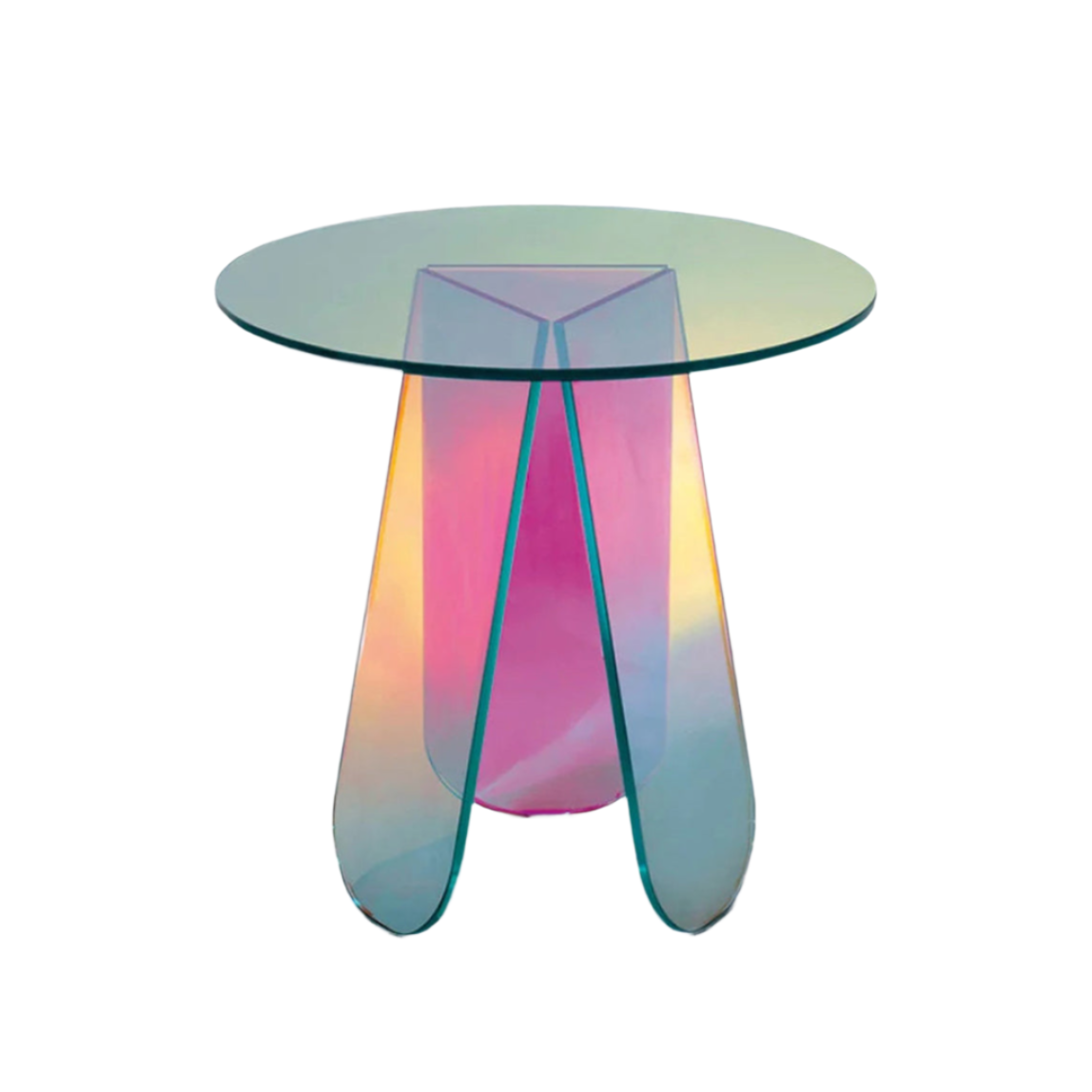
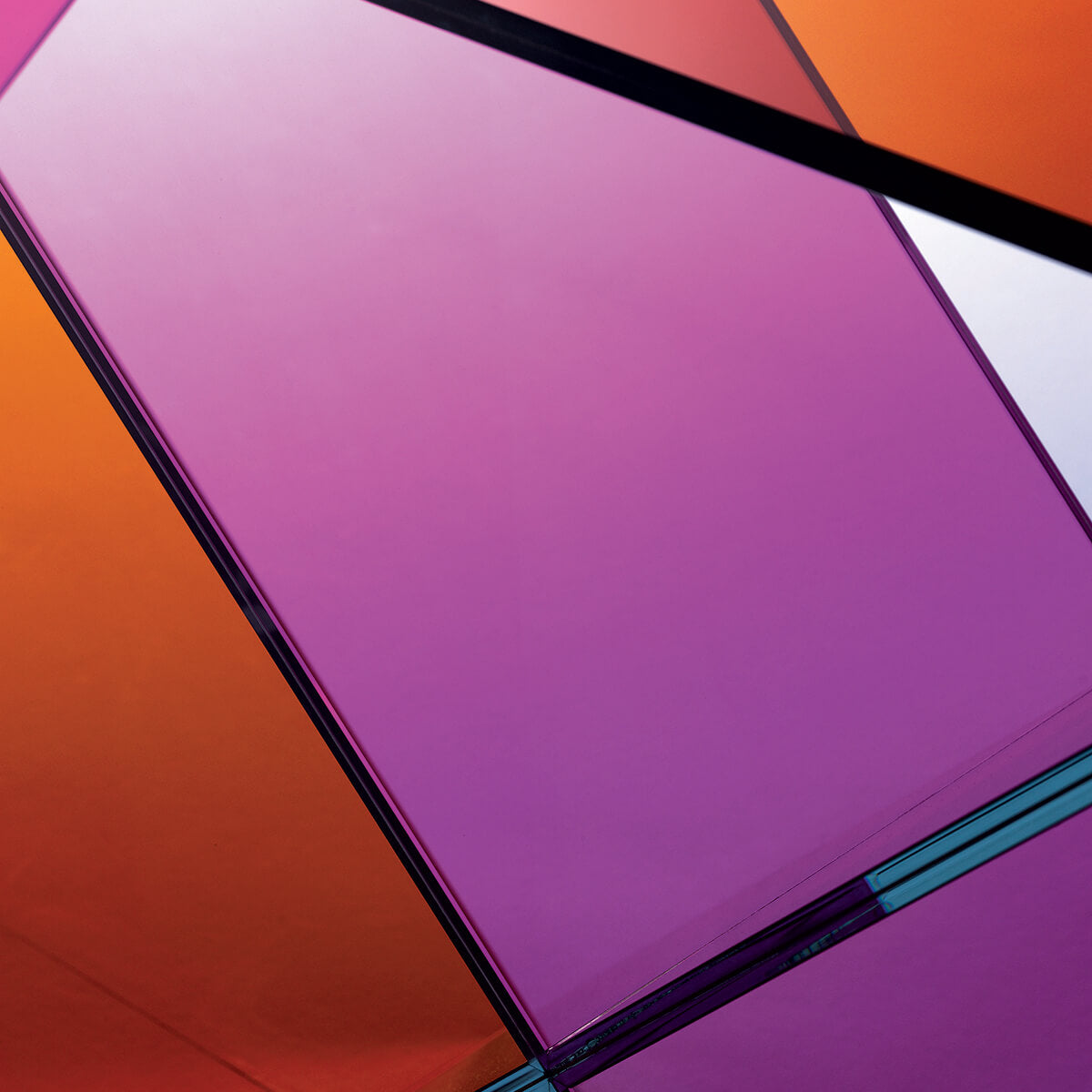
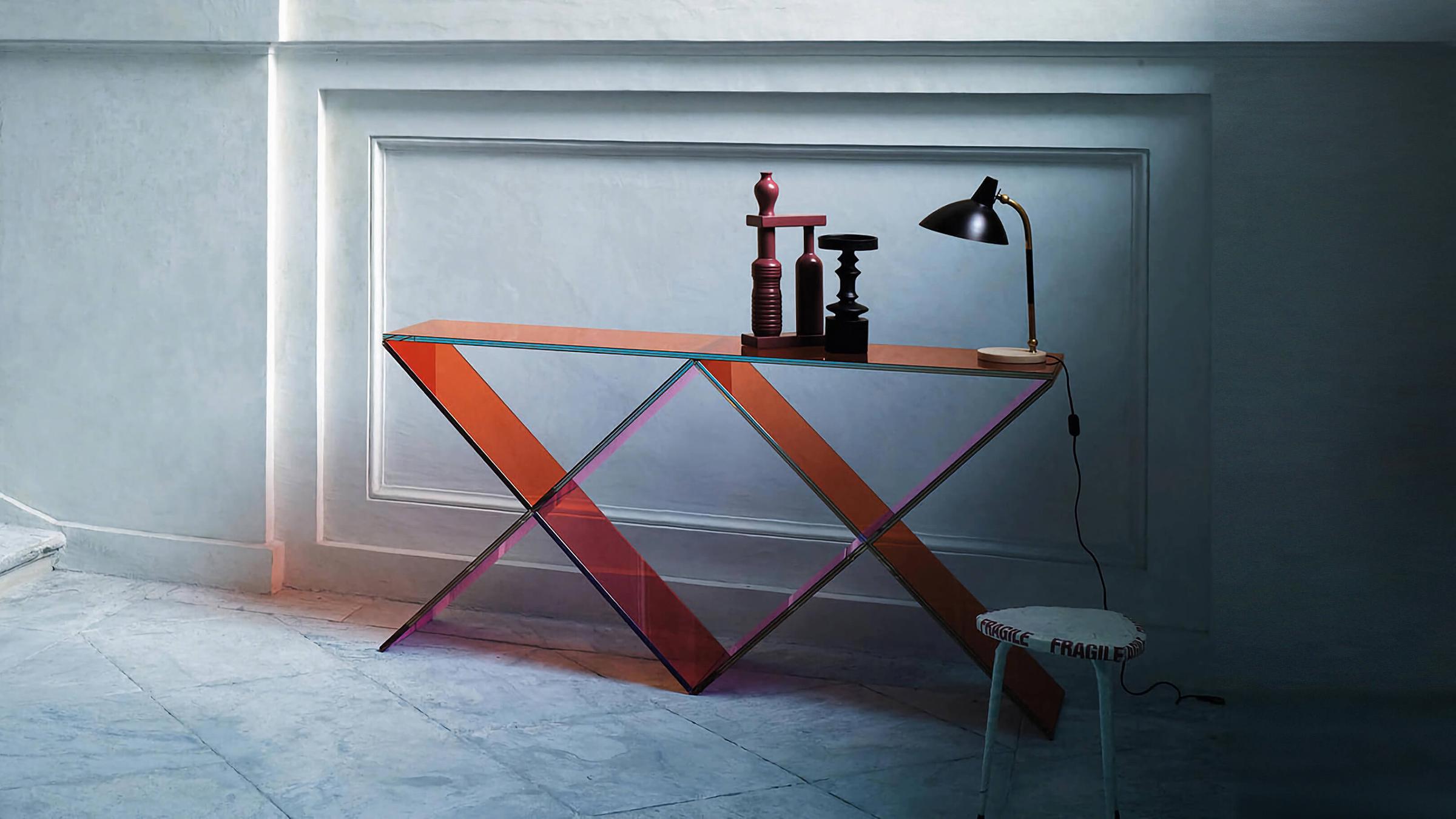
Color is introduced through several distinct techniques: laminating tinted film between glass sheets to build saturated gradients, applying chromatic coatings that shift hue as light angles change, etching surfaces to create translucency and opacity in the same plane, and bonding fabric or printed glass into structural panels. Each method is integral to the construction rather than applied after the fact, so the optical character is inseparable from the form. The Shimmer table by Patricia Urquiola is one example: refracted hues migrate across its surface as light shifts, with apparent transparency giving way to chromatic density depending on the angle.
Which designers collaborate with Glas Italia, and what sensibility do they bring?
Glas Italia works with a rigorously selective group of international designers whose practices share a commitment to material precision over decoration. Collaborators include Piero Lissoni, whose refined minimalism sits within Italian rationalist tradition, and Johanna Grawunder, a California-born designer long based in Milan whose work engages light, surface, and sculptural provocation. The unifying sensibility is restraint: each collaboration begins with what glass can do, not what it should look like.
How should I think about scale and proportion when specifying a glass dining table?
Glass dining tables read differently from solid-material counterparts because light passes through rather than stops at the surface. A glass table can anchor a room visually while preserving sightlines, making it a strong choice for smaller spaces or rooms with architecture worth exposing. Give the base geometry real consideration: thick laminated slabs read heavier than tubular supports, and colored or printed glass will define the room's palette more actively than clear extralight glass. Visiting a showroom is the most direct way to assess how scale, edge quality, and optical shift interact under actual light conditions. Confirm which Glas Italia pieces are currently on display before your visit, then schedule an appointment to make the most of your time on the floor.
What is extralight glass, and why does Glas Italia use it?
Extralight glass, also called low-iron glass, is produced with a significantly reduced iron content compared to standard float glass. Standard glass carries a faint green tint that becomes visible at the edges and across large surfaces. Extralight glass is optically neutral, transmitting color and light without distortion. For furniture where the glass is the material statement, this clarity matters: edges read white rather than green, and any applied color or finish appears as intended.
Can I experience Glas Italia pieces in person before purchasing?
Visiting a showroom is strongly recommended for glass furniture. Photographs rarely convey the actual weight, edge quality, optical shift across viewing angles, or the way a piece interacts with the specific light conditions of a room. Our showrooms in Miami, Chicago, Los Angeles, San Francisco, and Menlo Park carry significant Italian design collections. Confirm which Glas Italia pieces are currently on display before your visit. Explore the showroom network to find a location near you.
How do I care for and maintain glass furniture over time?
Most glass furniture requires only non-abrasive glass cleaners and soft cloths. Avoid anything with ammonia on lacquered or coated surfaces. Structural adhesive joints in quality Italian glass furniture are engineered for long-term stability, but sharp point impacts remain the primary vulnerability, as with any glass. Laminated glass constructions are significantly safer than monolithic panes in the event of breakage. For specific finishes, whether lacquered, etched, fabric-bonded, or colored, consult the care instructions provided with each piece.
Elevate Your Space
Since 1974, we have been at the forefront of innovation in the design sphere, revolutionizing perceptions of good design.


